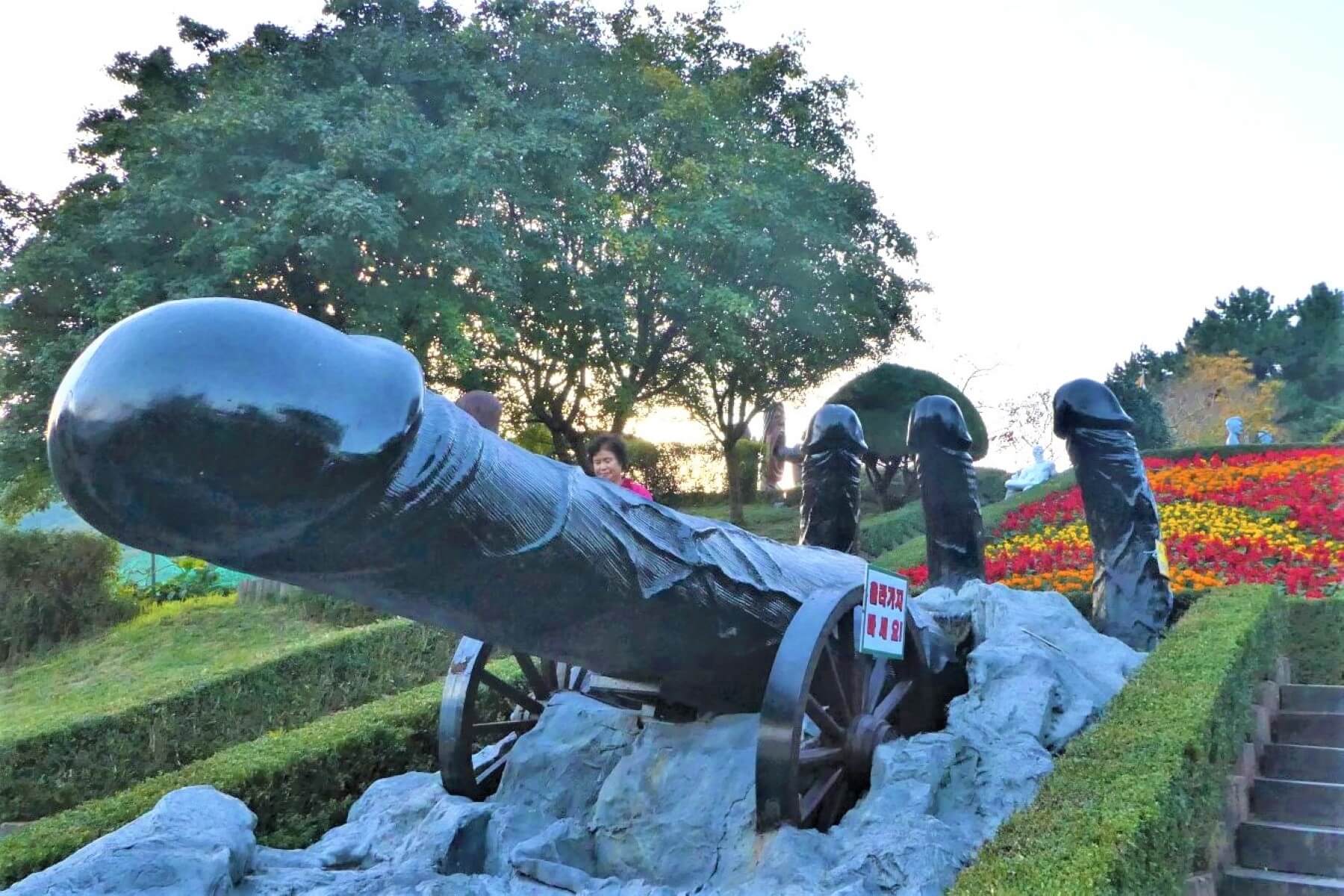
On the rugged east coast of South Korea lies one of the country’s most unusual attractions. Haesindang Park (해신당공원), near the small fishing village of Sinnam, is filled with hundreds of phallic sculptures in almost every imaginable shape and size. At first sight, it seems like little more than a very strange outdoor art park. But behind the statues lies a tragic local legend involving a young woman, a storm at sea and fishermen who suddenly found themselves without a catch.
Over the years, Haesindang has become better known internationally as the Penis Park of South Korea. Yet the park is also connected with the fishing traditions and folklore of this remote part of Gangwon Province. Add dramatic coastal scenery and a small museum about local fishing culture, and Haesindang becomes one of those wonderfully eccentric places that make travelling through South Korea so entertaining.
But why exactly are there hundreds of phallic sculptures overlooking the sea? To answer that question, we first have to discover the legend of a young woman whose death supposedly changed the fortunes of an entire village.
What will you discover?
- The tragic legend of Haesindang
- Why are there hundreds of phallic statues?
- From fishing legend to unusual sculpture park
- What can you see at Haesindang Park?
- The Fishing Folk Museum
- Is Haesindang Park worth visiting?
- Practical information and how to get there

The Tragic Legend of Haesindang
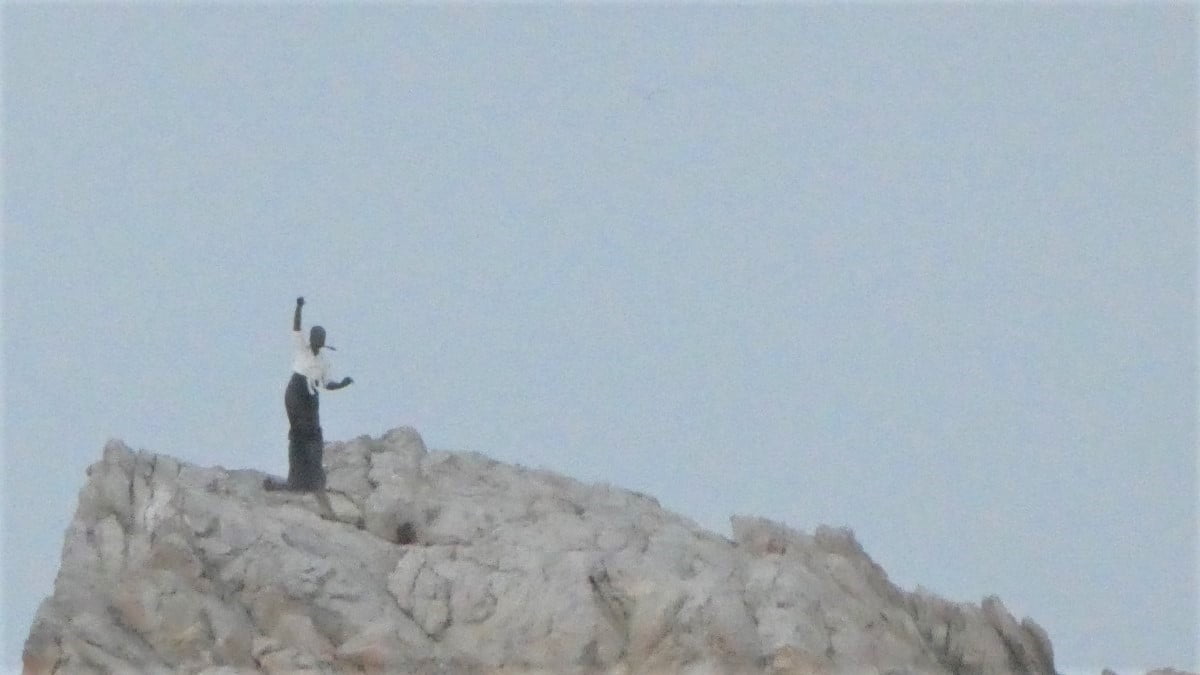
Like many good legends, the story behind Haesindang begins with love and ends in tragedy. According to local tradition, a young woman lived near the fishing village that is now known as Sinnam. Different versions of the story exist, but she is generally remembered as a young bride or unmarried woman waiting to marry her beloved fisherman. One day, the fisherman took her to a rocky outcrop offshore. He intended to collect her again after finishing his work at sea.
But the weather changed. A storm developed and rough waves struck the rocks. Before the fisherman could return, the young woman was swept into the sea and drowned. Her death supposedly had unexpected consequences for the village.
In the days that followed, the fishermen returned from the sea with almost nothing. The fish appeared to have disappeared from the waters around Sinnam. Nets that had once provided the villagers with their livelihood suddenly came back empty. The villagers began to believe that the spirit of the drowned woman was responsible. And according to the legend, she was not happy.
Why Are There Hundreds of Phallic Statues?
This is where the story becomes considerably stranger. One version of the legend tells of a fisherman who relieved himself while facing the sea. Shortly afterwards, fish supposedly returned to the waters around the village. The villagers interpreted the event as a sign. Apparently, the spirit of the drowned woman could be appeased by the sight of the male anatomy.
From then on, local fishermen began making phallic offerings in the hope that her spirit would remain satisfied and that the sea would continue providing them with a good catch. Whether anyone in Sinnam genuinely believed every detail of this story is impossible to establish from the legend alone. Like so much traditional folklore, the tale has probably changed as it was passed from one generation to another. But the basic story survived. And eventually an entire park grew around it.

From Fishing Legend to Haesindang Park
Today, Haesindang is far removed from a few simple offerings left by fishermen. The modern Haesindang Park developed into an outdoor sculpture park overlooking the East Sea. A sculpture competition contributed many of the works now found throughout the grounds, transforming an old piece of village folklore into a rather extraordinary tourist attraction.
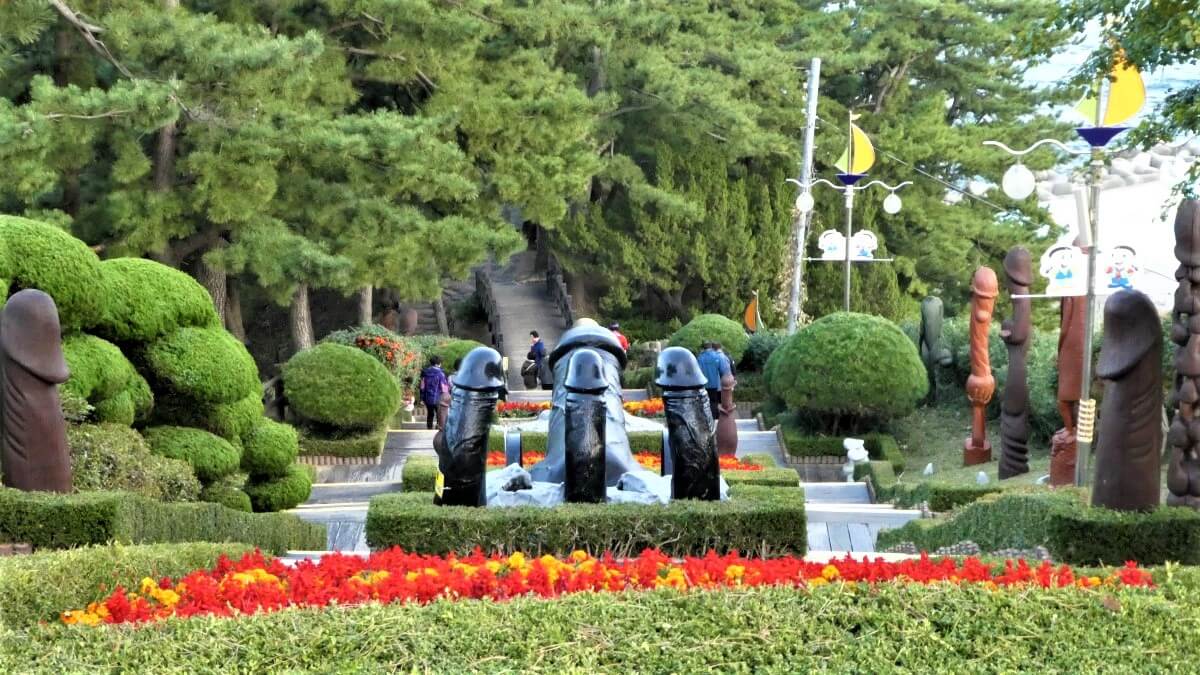
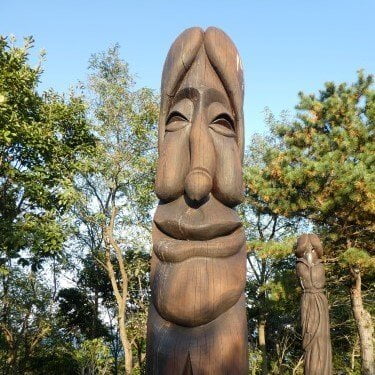
Visitors encounter wooden and stone phalluses carved into all kinds of shapes. Some stand several metres high. Others have faces, decorations or humorous details. There are benches, statues, elaborate carvings and objects whose purpose becomes obvious as soon as you look at them. The result is somewhere between a folklore park, an open-air art exhibition and an adult-themed attraction.
But despite its modern humour, the original connection with the sea remains important. Haesindang stands above the coastline of Sinnam, a community whose history depended heavily on fishing. Seen from that perspective, the park is not simply about sex. The sculptures are connected with older beliefs about fertility, fortune, spirits and the unpredictable relationship between coastal communities and the sea.
That makes the history considerably more interesting than the nickname “Penis Park” initially suggests.

What Can You See at Haesindang Park?
The main reason most people come here is obviously the sculptures. As you walk through the grounds, they appear everywhere. Some look like traditional wooden carvings, while others are deliberately comic or exaggerated. There are large sculptures standing among the trees, smaller examples gathered together and even pieces of park furniture shaped around the same theme.
You probably won’t need an entire day. Allow roughly one to two hours if you want to walk through the park, take photographs, enjoy the coastal views and visit the museum. One of the pleasant surprises is the location itself. Haesindang overlooks a dramatic section of South Korea’s eastern coastline, and parts of the walk offer beautiful views across the sea.
That contrast is part of the fun. One moment you are admiring the Korean coastline; the next you turn around and find another enormous phallic sculpture staring back at you. It certainly isn’t a conventional historical attraction.

The Fishing Folk Museum
Your entrance to Haesindang Park also gives you an opportunity to learn more about the community behind the legend. The Fishing Folk Museum focuses on the traditional life of fishermen in the region. Displays cover subjects such as fishing culture, local customs and the story associated with Haesindang. For Travel4History, this is actually one of the more useful parts of the visit.
Without the fishing history, the sculptures can easily seem like little more than a collection of amusing objects designed to attract tourists. The museum provides the wider context: Sinnam was a coastal community whose inhabitants depended on the sea for food and income.
In fishing societies, good fortune mattered. Storms could kill fishermen. A bad catch could threaten families. Folklore, rituals and offerings therefore developed around forces that people could not control. The strange legend of Haesindang belongs to that wider world. It just happens to have produced one of the most unusual collections of sculptures in South Korea.
A Different Side of Korean Folklore
Haesindang may seem bizarre, but phallic symbolism itself is hardly unique to this corner of Korea. Across different cultures and periods of history, the phallus has been associated with fertility, protection, prosperity and good fortune. What makes Haesindang unusual is the way these ideas became connected with a specific coastal legend and were eventually transformed into a modern attraction. The park therefore sits somewhere between old and new Korea.
Its story supposedly begins with fishermen and village beliefs, while the sculptures visitors see today are modern interpretations of that tradition. That also explains why Haesindang feels quite different from visiting a palace in Seoul or a Buddhist temple in Gyeongju. You aren’t studying kings, dynasties or wars here. You are discovering folk history: the stories ordinary communities created to explain misfortune, nature and forces beyond their control. Even when those stories become rather ridiculous.

Is Haesindang Park Worth Visiting?
I wouldn’t travel across the whole of South Korea solely to see Haesindang Park. But if you’re already travelling along the eastern coast or exploring the area around Samcheok, it is a very entertaining detour. The park is unusual, photogenic and easy to explore. More importantly, there is actually a historical story behind all those statues. Add the museum and the coastal scenery and it becomes much more interesting than its nickname suggests.
Don’t expect a serious museum experience. Haesindang is quirky, occasionally absurd and deliberately humorous. And that’s exactly why it is memorable. South Korea has magnificent palaces, ancient temples, traditional villages and enormous historical museums. Haesindang shows another side of the country’s heritage: local folklore with a sense of humour.
Practical Information for Haesindang Park
Haesindang Park lies near Sinnam, south of Samcheok on South Korea’s east coast. A rental car is the easiest option, particularly if Haesindang is one stop on a road trip along the coast. It gives you the freedom to combine the park with other places around Samcheok and leave whenever you’ve seen enough phallic sculptures for one day.
Travelling by public transport is also possible. Buses operate from the Samcheok area towards Sinnam, although services in rural areas can be limited. Check the latest local timetable before travelling. Opening hours and admission prices can change, so I recommend checking the current information shortly before your visit rather than relying on older prices. Allow around one to two hours for the park and museum.

So, should the Penis Park be on your South Korea itinerary?
Haesindang Park will never compete with South Korea’s great palaces or UNESCO World Heritage Sites for historical importance. But it doesn’t need to. It tells the story of a fishing village, a drowned woman, an angry spirit and a wonderfully improbable solution involving hundreds of phallic statues.
How much of the legend is history and how much is storytelling hardly matters anymore. The tale became part of Sinnam’s identity, and today it attracts curious travellers from around the world. Come for the strange sculptures, stay for the coastal scenery — and leave knowing that even South Korea’s craziest penis park has a history behind it.
Return to:

4 comments
When was the Penis Park in Sinnam constructed ?
The Penis Park in Sinnam opened in 2007! I see I didn’t write it down. Thanks!
Where is the vagina park?? I have no intention of going to penis park but my wife wants to?? There has to be a pussy park.. is there???
I never knew about this. I am just now finding out. I wish I could go and visit.