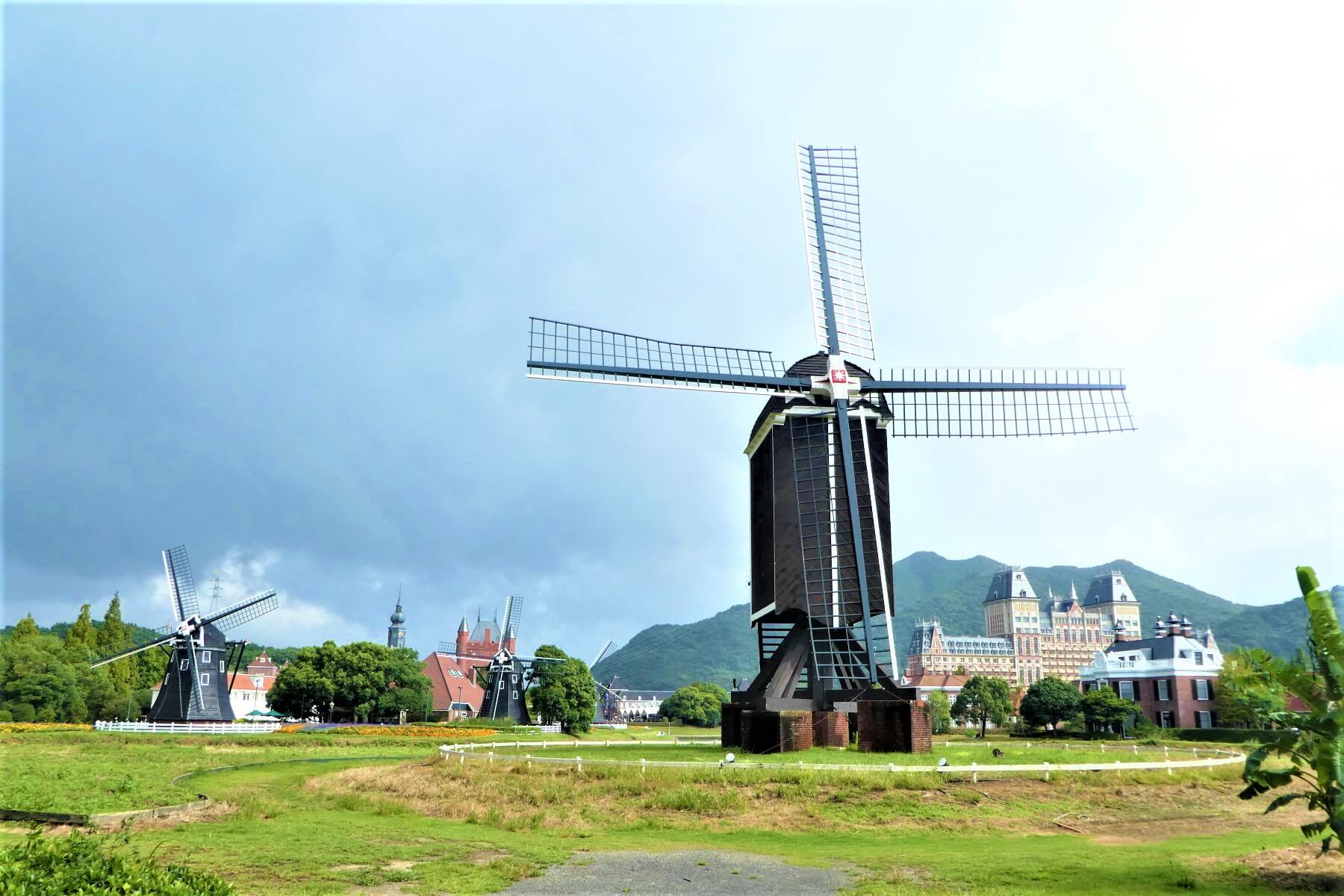
Windmills, canals, Dutch houses and colourful tulips — in Japan? Welcome to Huis ten Bosch, a remarkable Dutch-themed park near Sasebo in Nagasaki Prefecture. The park recreates the atmosphere of the Netherlands with canals, bridges, historic-looking buildings and replicas of famous landmarks. But why was a miniature version of Holland built in Japan? In this article, you will discover the history of Huis ten Bosch, what you can see and whether it is worth visiting during your trip to Kyushu.
What will you discover?
- How did a Dutch theme park end up in Japan?
- Building a little Netherlands in Nagasaki
- What can you see at Huis ten Bosch?
- Canals, windmills and flowersIs
- Huis ten Bosch worth visiting?
- The historical connection with Nagasaki
- Staying overnight at Huis ten Bosch
- How to get to Huis ten Bosch
- Tickets and opening hours
- My conclusion: a little piece of Holland in Japan
How did a Dutch theme park end up in Japan?
The story of Huis ten Bosch begins with Japanese businessman Yoshikuni Kamichika. In 1979, Kamichika travelled through Europe looking for ideas to attract more visitors to the Nagasaki region. During his journey, he visited the Netherlands and became fascinated by the country. He admired its architecture and landscapes, but was particularly impressed by the Dutch relationship with water and their centuries of experience in water management.
There was another important reason why the Netherlands was such a logical source of inspiration: Japan and the Netherlands share a long history. For more than two centuries, the Dutch were among the very few Europeans allowed to trade with Japan. During Japan’s period of isolation under the Tokugawa shogunate, Dutch merchants conducted their business from Dejima, a small artificial island in the harbour of Nagasaki.
Nagasaki therefore became an important gateway through which Western knowledge entered Japan. Kamichika decided to use this historic connection as the inspiration for a new tourist attraction. In 1983, he opened Nagasaki Holland Village, a smaller Dutch-themed attraction. Its success eventually led to a much more ambitious project: Huis ten Bosch. Construction began in 1988.
Building a little Netherlands in Nagasaki
Huis ten Bosch was designed as much more than a collection of windmills and Dutch souvenir shops. The aim was to create the feeling of walking through an actual European town. Around six kilometres of canals were constructed, while hundreds of thousands of trees and flowers were planted throughout the area. Dutch-style streets, houses, bridges and squares appeared along the waterways. Some buildings were inspired by well-known landmarks in the Netherlands, and building materials were even imported from the country to make the architecture look more authentic.
The project reportedly cost several billion dollars. On 25 March 1992, Huis ten Bosch officially opened. The park takes its name from Huis ten Bosch Palace in The Hague, one of the official residences of the Dutch royal family. A reconstruction of the palace is also one of the main landmarks inside the Japanese park. The exterior resembles the Dutch palace, although the interior is not an exact copy. The result is an unusual combination of Dutch architecture, Japanese attention to detail and modern theme-park entertainment.
What can you see at Huis ten Bosch?
Walking through Huis ten Bosch is a strange experience, especially if you are familiar with the Netherlands. One moment you are travelling through southern Japan; the next, you are surrounded by canals, brick houses, windmills and European-style squares. Several buildings were inspired by famous Dutch landmarks. One of the most recognisable is a recreation of Amsterdam Central Station, while elsewhere you can see a tower inspired by the Dom Tower in Utrecht.
There are Dutch-style houses, harbour buildings, bridges and, of course, the reconstructed Huis ten Bosch Palace. And what would a Dutch theme park in Japan be without Miffy? The famous rabbit created by Dutch illustrator Dick Bruna is extremely popular in Japan and has a prominent place in the park. For Dutch visitors, it is particularly entertaining to see which details look familiar and which ones clearly reflect a Japanese interpretation of the Netherlands.
Canals, windmills and flowers
One of the nicest aspects of Huis ten Bosch is simply walking around the park. A large network of canals runs through the grounds, creating the appearance of a European waterfront town. Combined with bridges, windmills and rows of colourful buildings, the scenery makes Huis ten Bosch very photogenic. Flowers also play an important role.
Depending on the season, you can see large displays of tulips and other colourful flowers throughout the park. Tulips are, of course, particularly fitting for a destination inspired by the Netherlands. Today, Huis ten Bosch is much more than just a recreation of Holland. The park also offers attractions, restaurants, shops, seasonal events and entertainment. In the evening, large-scale illuminations transform the park. Staying until after sunset therefore gives you a completely different impression from visiting only during the daytime.
Is Huis ten Bosch worth visiting?
So, should you include Huis ten Bosch in your Japan itinerary? That mainly depends on what you are looking for. If your priority is traditional Japanese temples, castles and historic neighbourhoods, there are more important places to visit in Kyushu. Huis ten Bosch is obviously not a historical attraction in the same sense as Dejima or the historic sights of Nagasaki. But its unusual character is exactly what makes it interesting.
I visited Huis ten Bosch in September 2017. As a Dutch visitor, seeing familiar architecture recreated on the other side of the world was both strange and fascinating. At the time, visitors could choose between different tickets, including a cheaper ticket without access to all the attractions. I chose that option because I mainly wanted to explore the park, see the Dutch buildings and experience the atmosphere.
Even without spending an entire day on attractions, I found the visit memorable. For international travellers, it can also be a fun change from temples, shrines and traditional Japanese cities.Is Huis ten Bosch worth visiting?
The historical connection with Nagasaki
The location of Huis ten Bosch in Nagasaki Prefecture is not entirely coincidental. The Netherlands and Japan have maintained relations for more than four centuries. Dutch merchants arrived in Japan in the early seventeenth century. After other European powers were expelled, the Dutch East India Company was allowed to continue trading from Dejima in Nagasaki. For more than 200 years, Dejima served as an important window through which Western science, medicine and technology entered Japan.
This exchange contributed to what became known as Rangaku, or “Dutch learning”. Japanese scholars studied Dutch books to learn about subjects such as medicine, astronomy, geography and science. If you are interested in this history, I recommend combining Huis ten Bosch with a visit to Dejima in Nagasaki. The two places show very different sides of the relationship between the Netherlands and Japan. Dejima tells the historical story, while Huis ten Bosch shows how Dutch culture has been reinterpreted as a modern Japanese attraction.
Staying overnight at Huis ten Bosch
You can visit Huis ten Bosch as a day trip, but staying overnight is also possible. Several hotels are located in and around the resort. This can be convenient if you want to experience the evening illuminations or spend a full day enjoying the attractions. Some accommodation fits nicely into the European atmosphere, while there are also waterfront cottages and larger hotels close to the entrance.
When I visited Huis ten Bosch, I travelled from Nagasaki in the morning and continued to Fukuoka later that afternoon. If you are travelling with luggage, lockers are available around the railway station, allowing you to explore the park without carrying your suitcase or backpack.
How to get to Huis ten Bosch
Huis ten Bosch has its own railway station, making it relatively easy to reach by public transport. From Nagasaki, you can travel by train to Huis Ten Bosch Station. Depending on the service and connections, the journey generally takes around one to two hours. From Fukuoka, trains run from Hakata Station towards Huis Ten Bosch Station. Depending on the timetable, direct limited express trains may be available, while some journeys require a transfer.
The railway station is within walking distance of the entrance to the park. If you are travelling around Kyushu by rental car, Huis ten Bosch can also easily be combined with Sasebo and other destinations in Nagasaki Prefecture. Always check the latest train schedules before travelling, as services can change.
Tickets and opening hours
Ticket prices and opening hours at Huis ten Bosch can vary depending on the season, weekends, public holidays and special events. The attractions included with admission may also change over time.
For that reason, it is best to check the official Huis ten Bosch website shortly before your visit rather than relying on older prices or opening hours.If you want to experience both the Dutch-style architecture and the evening illuminations, consider arriving around midday and staying until after sunset.
My conclusion: a little piece of Holland in Japan
Huis ten Bosch is certainly one of the most unusual places I visited in Japan. Is it really the Netherlands? Of course not. But that is exactly what makes it so entertaining. The canals, windmills, colourful houses, flowers, Miffy and replicas of famous buildings create a version of the Netherlands seen through Japanese eyes. At the same time, its location near Nagasaki gives the park a genuine connection to the long history between Japan and the Netherlands.
If you only have limited time in Japan, Huis ten Bosch probably does not belong at the top of your itinerary. But if you are travelling through Kyushu, staying in Nagasaki or visiting Sasebo, it can be a fascinating and enjoyable day trip. And if you are Dutch, seeing Amsterdam Central Station, the Dom Tower and Dutch windmills surrounded by the landscape of southern Japan is certainly an experience you will not forget quickly.
Welcome to Holland — in Japan.
Maybe also interesting?
- Dejima, Nagasaki: Inside Japan’s Dutch Trading Post
- Glover Garden, Nagasaki: The Scottish Merchant Who Helped Modernize Japan
- The Atomic Bomb Route in Nagasaki: 7 Places That Tell the Story of August 9, 1945
Return to:
