
Nikko National Park (日光国立公園) is among one of Japan’s most beautiful national parks. Located 150 kilometres north of the capital Tokyo, it possesses one of the country’s most important temple complexes. A day trip or a few days exploring the park is therefore highly recommended. Not only for making beautiful walks, but also for discovering some special historical attractions.
Are you planning a visit to Nikko? In this travel guide, I will take you to the park’s best landmarks, discover the best accommodation and find out more about the special history of this beautiful national park in Japan. A history-rich visit to Nikko National Park starts here…
This travel guide of Nikko National Park contains affiliate links. This means if you make a booking through one of the links on this website, Travel4history gets a small compensation for it. This doesn’t cost you anything extra by the way!
In this Travel Guide to Nikko National Park
- Practical Information
- Best travel time?
- How many days?
- History – What makes Nikko National Park historically interesting?
Plan your trip to Nikko & Japan
- Accommodation: Hotel or Hostel?
- Activities: Tickets & Tours, including A day Trip from Tokyo
- Transport by Air? Flight Tickets
- Own Transport?: Rent a Car
- Train tickets: Japan Railway Pass – 7, 14 or 21 days?

Practical Information for a Visit to Nikko National Park
Best travel time?
The best time to travel to Nikko National Park is in spring (April/May) and fall (September/October). In spring, the park is incredibly popular for its cherry blossoms, and in fall for its beautiful autumn colors. During both these periods, the temperature will be between 15 and 25 degrees. In summer it is about 25 to 30 degrees.
How many days?
It is possible to visit Nikko in one day. By Shinkansen (high-speed rail) you can get there in about 2 hours. If you only want to visit the park for its historical sights, 1 day is enough. But would you like to see more and take a beautiful hike? Then opt for a visit of at least 2 full days.
History – What makes Nikko National Park historically interesting to visit?
Nikko National Park is extremely popular among Japanese people. They see this place as a kind of pilgrimage site and visit the temples founded here more than 1,000 years ago.
In fact, it was the monk Shodo Shonin (735-766) who visited this place in 766 AD. He crossed the Daiya River by the use of two snakes. This is where Japan’s most photographed bridge, the Shinkyo Bridge, now stands.
Then, on the other side of the river, Shonin founded the Rinnoji Temple. He also founded the Futarasan Shrine. He continued his way through the park, climbing the famous Mount Nantai and visiting Chuzenji Lake. At Chuzenji Lake, he established the Chuzenji Temple.
Another important event in Nikko National Park was the construction of the mausoleum for Ieyasu Tokugawa (1543-1616). He was the first ruler of the Edo shogunate. This family ruled Japan from 1602 to 1868. Ieyasu Tokugawa had a mausoleum built in this park with more than 500 kilos of gold leaf. This is now the most impressive temple in the park (and the most expensive!).
In 1934 the park was given National Park status by the Japanese government. And in 1999, UNESCO placed it on the World Heritage List because of the important historical value of the temples that can be seen here.
So now you know why a visit to this park is historically very interesting.
Sightseeing – 7 things to do in Nikko National Park
The best time to travel to Nikko National Park is between April and November. In October and November, the park is covered in beautiful colors due to the autumn leaves.
However, are you planning to go to Nikko in the summer? It can be quite busy then. Not only tourists but also the local population likes to come here. It is recommended to visit the temples early in the morning or at the end of the afternoon when the buses with tourists have left.
There are many beautiful walks to be taken in Nikko. The most famous one is the hike to Mount Nantai, the highest mountain in this area. It is located by Lake Chuzenji. This hike will take around 4 or 5 hours. Would you prefer to have a more relaxing time and see some special sights? Then read on and discover 7 historical places with an impressive story…

1. Discover the place where Shodo Shonin crossed the Daiya River…
This is the first historical site you will see in Nikko National Park. It is Japan’s most famous and photographed bridge, the Shinkyo Bridge (神橋). The monk Shodo Shonin decided to cross the river and prayed to God for a happy outcome. He helped Shonin by sending two snakes that formed a bridge.
The monk crossed the river in 766 and founded a few temples on the other side. The current bridge has been in place since 1904, after a storm destroyed the former bridge. As far as we know, the bridge has existed since 1673, but it could also be older.
You can walk on it for a small fee. But the best thing to do is to take a picture of the Shinkyo bridge and the beautiful colourful area.
2. Go to Nikko’s main temple, the Rinnoji Temple
After Shodo Shonin crossed the river, he founded the Rinnoji Temple (輪王寺) in 766. It was first called the Shihonryu Temple, but with its foundation he introduced Buddhism to the region.
Around 800 Rinnoji Temple became part of the Tendai, a Japanese movement within Buddhism. In the following centuries, the complex expanded considerably and many important monks visited this place. Expect a visit to this temple to take about 1 or 2 hours.

3. Toshogu Shrine: Visit the mausoleum and the golden Temple
The Toshogu Shrine (東照宮) is a tribute to the first shogun (leader) of the Tokugawa shogunate: Ieyasu Tokugawa (1543-1616). He founded the Edo Shogunate in 1603, which lasted until 1868. He was closely involved in the design, but wanted it all to be more sober than it is now. Containing more than 500 kg of gold leaf, this temple is Nikko’s most visited attraction. And therefore also the most expensive. The complex is full of symbolism and behind the Golden Temple you can visit his mausoleum.
Would you like to know more about the Toshogu Shrine? Read the article Toshogu Shrine | A historical explanation of this Golden Temple
4. The Futarasan shrine in honour of Mount Nantai
In 782, the monk Shonin founded a second temple in Nikko, the Futarasan shrine (二荒山神社). This shrine is dedicated to the gods of Mount Nantai, Nyoho and Taro. These mountains are located in Nikko. A part of the complex can be visited for free and contains a number of gardens and a number of small temple buildings. For the main building, a small fee has to be paid.
At the foot of the mountain, as well as on Mount Nantai, there is also a smaller version of the Futarasan Shrine

5. Kegon Falls: The most beautiful waterfall in Japan, but with a dark side…
Kegon Falls (華厳の滝) belongs to one of the three most beautiful falls in Japan. The water, originating from Lake Chuzenji, cascades down about 100 metres into a gorge. The view from the platform is breathtaking. But this place also has a dark side.Did you know that Kegon Falls was a popular place to commit suicide around 1900? More than 200 people committed suicide here. And it all started with the suicide of Misao Fujimura (1886-1903) at a time when Japan was rediscovering itself.
Curious about the background to this story? Read the article Kegon Falls | Why 200 people committed suicide in Nikko
6. Taiyuin, the mausoleum of Iemitsu Tokugawa
Within walking distance of Toshogu Shrine you will find Taiyuin (大猷院), the mausoleum of Iemitsu Tokugawa (1604-1651). He was the third leader of the Tokugawa Shogunate, and grandson of its founder Ieyasu Tokugawa. He too has been given a resting place in Nikko National Park, although Iemitsu himself indicated that he preferred a more sober mausoleum and temple out of respect for his grandfather.
But then again, could it be more lavish than the Toshogu Shrine? Nevertheless, Taiyuin is also very beautiful and full of symbols. Like the Toshogu Shrine, this temple is also a mix of Buddhist elements and Shinto, the original religion of Japan where nature gods are worshipped.
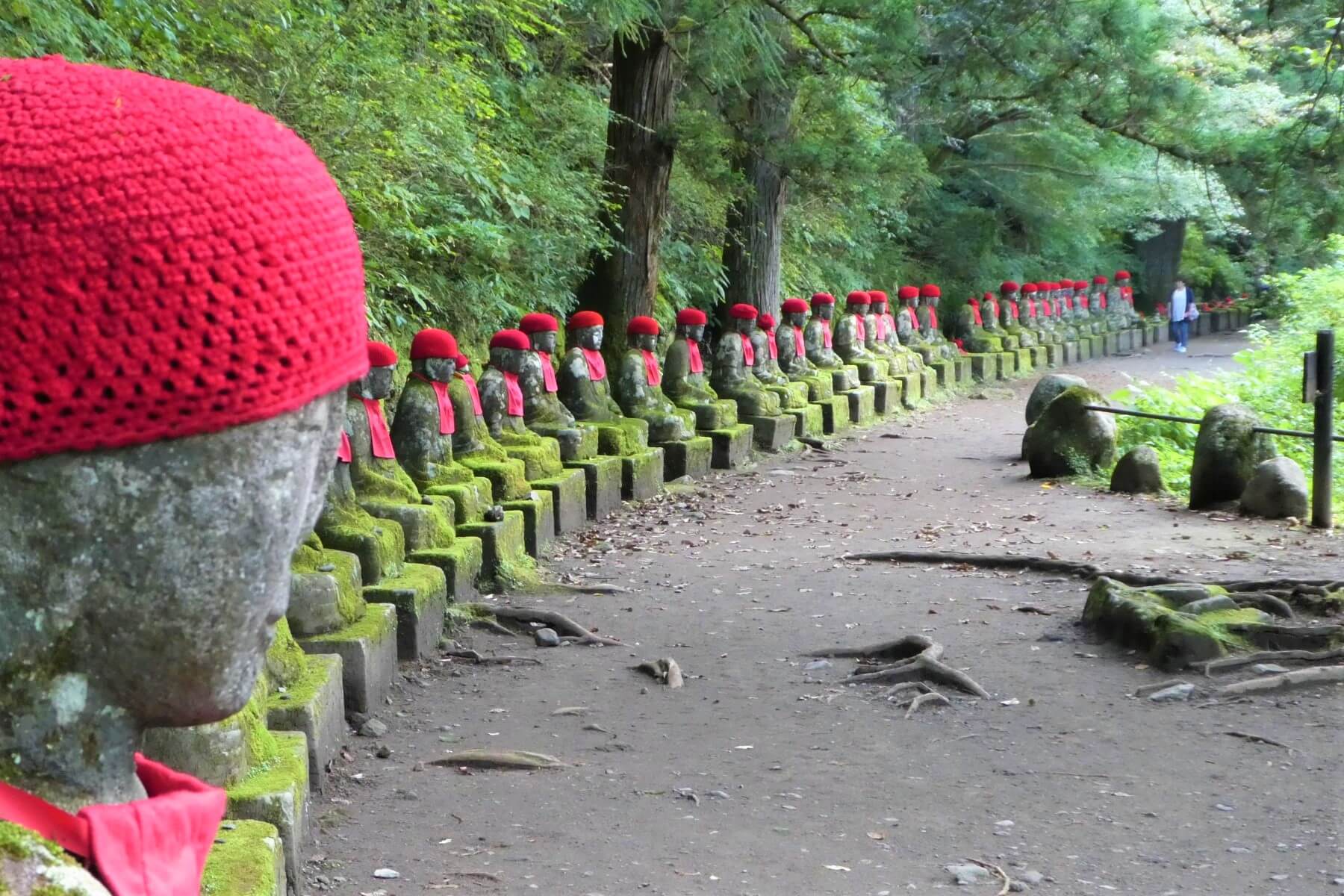
7. Walk through the Kanmangafuchi Abyss
The Kanmangafuchi Abyss (憾満ヶ淵) is a gorge formed by the eruption of Mount Nantai over 7000 years ago. Seen from the Nikko temple complex, it is located on the other side of the Daiya River, in a quiet area. It is a short walk that takes about one hour. Unless… you start counting the mysterious Jizo statues. According to this legend, you can’t count them because one always disappears. And why are those statues with red scarves standing there?
Curious about the background of these mysterious statues with red caps and scarves? Read the article Kanmangafuchi Abyss | The story of the mysterious Jizo statues.
Accommodation – Where to stay in Nikko National Park?
Those who have decided to stay at least one night in Nikko National Park will no doubt be wondering where the best accommodation can be found. The most common places are near the two train stations, near the temples or, for example, near Lake Chuzenji. For the latter, you have to travel 40 minutes by bus. Below are a number of historical options.

Hostel: Nikko Sumica Guesthouse (budget) is a small hostel that is run by a nice couple. In the evening they sometimes play a game, think about sumo wrestling! Only not with real people, but with two figures on a game board. By tapping the table, vibrations make the figures move. And whoever is on top wins.
Hotel: The most famous hotel in Nikko is the Kanaya Hotel. During the Second World War, the emperor and his family stayed here. From 1945 to 1952, it was the residence of American officers. But also some famous stars stayed here, like Albert Einstein (scientist), Charlie Chaplin (film star) and Frank Lloyd Wright (architect/writer). Prices for a room in this 4-star hotel start at €200 per night.
Onsen: Are you more of a relaxation type and would like to visit a typical onsen (hot springs)? Then go to Okunikko Yumoto Onsen. The first time an onsen here was mentioned in documents was in 788. The small town of Yumoto has a number of hotels, and for the rest you can visit a temple or the Yudaki Falls. The town is situated beyond Chuzenji, so it is best to buy a 2-day bus ticket from the Nikko bus station.

Transport – How to get to Nikko National Park?
The easiest way to reach Nikko National Park from Tokyo is by high-speed train, the Shinkansen. In between you change trains in Utsunomiya. The JR Tobu line will take you from Utsonomiya to JR Tobu Station in Nikko.The total journey from Tokyo takes about 2 hours. With the JR pass, you can use all government lines known as JR for 1, 2 or 3 weeks. There is also a private line that goes to Nikko, but this is generally more expensive.
You can find out more about the Tokyo – Nikko route from the Hyperdia website.
Once in Nikko, it is about a 30-minute walk to the famous Unesco temples. But it is also possible to take the bus. For more information take a look at the website of Tobu Bus.
Next destination in Japan?
Continue your trip through Japan to Tokyo, Mount Fuji or Nagano.
Do you have more nice tips, remarks or ideas about Nikko National Park in Japan? Feel free to leave a message below.
