
Vinci
Leonardo da Vinci, Renaissance innovation and Tuscan heritage
Discover Vinci through Leonardo da Vinci’s life, medieval streets, interactive museums and the Tuscan landscape that shaped his early years, with a practical three-day itinerary connecting the historic centre, Anchiano and the surrounding Montalbano hills.
INTRODUCTION
Introduction
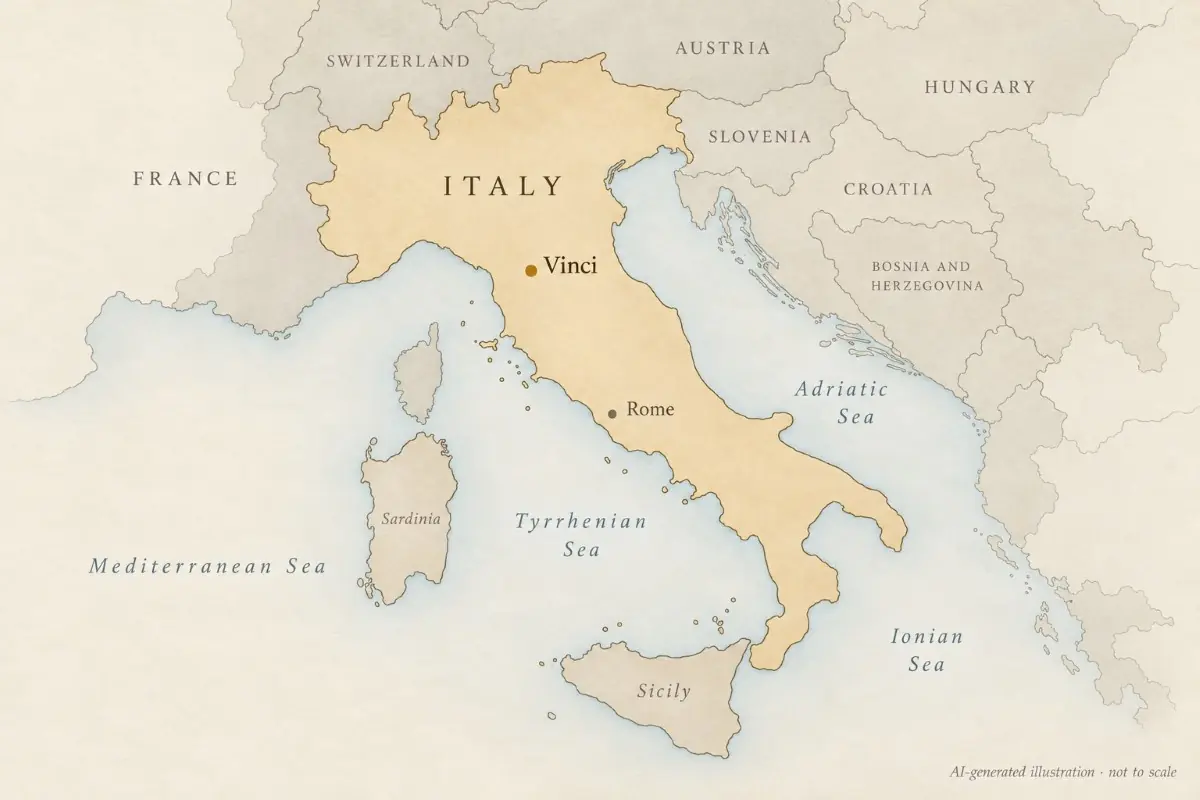
Vinci is a small Tuscan hill town best known as the birthplace of Leonardo da Vinci. Medieval streets, the Conti Guidi Castle and museums devoted to Leonardo place the Renaissance master within the rural landscape of olive groves and hills that surrounded his early life.
One full day covers Vinci’s principal sights, but two or three days allow time for Anchiano, countryside walks and nearby Tuscan towns. Staying overnight also reveals a quieter side of Vinci after most day visitors have left.
WHY VISIT
Why Visit Vinci?
Vinci offers one of Tuscany’s clearest connections between place, landscape and Renaissance creativity. The town combines Leonardo-related museums with medieval architecture, countryside paths and a compact historic centre that is easy to explore at a relaxed pace.
01
Leonardo da Vinci & His Birthplace
Leonardo da Vinci was born in 1452 in the countryside near Vinci. His birthplace at Anchiano and the town’s museums help connect his inventions, drawings and scientific curiosity with the landscape and communities of fifteenth-century Tuscany.
02
Museo Leonardiano & Renaissance Innovation
The Museo Leonardiano uses models, reconstructions and exhibits to explore Leonardo’s studies of machines, engineering, anatomy and nature. It is the essential cultural attraction in Vinci and gives practical context to his notebooks and ideas.
03
The Medieval Castle & Historic Vinci
Vinci developed around the fortified Conti Guidi Castle, whose tower still dominates the historic centre. Narrow lanes, stone buildings and small piazzas preserve the scale of a medieval Tuscan settlement beneath the later fame of Leonardo.
04
The Montalbano Landscape
Olive groves, vineyards and low hills surround Vinci and form an important part of the experience. Walking between the town and Anchiano helps explain the rural environment in which Leonardo spent his earliest years.
HISTORY
A Short History of Vinci
The area around Vinci was settled long before the Renaissance, but the medieval town grew around a castle controlled by the Counts Guidi. Its hilltop position overlooked routes and farmland in the Montalbano area between Florence and the Arno Valley.
Florence gradually extended its influence over the area, and Vinci became part of the Florentine state. The town remained a small agricultural centre whose most famous resident was born nearby in 1452: Leonardo, the illegitimate son of the notary Ser Piero da Vinci.
Leonardo left the area as a young man and built his career in Florence, Milan and other courts, but Vinci later became closely identified with his legacy. During the twentieth century, museums and cultural institutions transformed the town into an important centre for studying and presenting Leonardo’s work.
KEY HISTORICAL MOMENT
1452
Leonardo da Vinci was born on 15 April 1452 near Vinci. His early years in the Tuscan countryside preceded his move to Florence, where he entered the workshop of Andrea del Verrocchio and began the career that would make him one of the defining figures of the Renaissance.
TOP SIGHTS
Top Sights in Vinci
These eight sights connect Leonardo’s life, Vinci’s medieval history and the Tuscan landscape around the town. The museums are essential, but Vinci is most rewarding when you combine them with the castle, church, Anchiano and the surrounding countryside.
1
Museo Leonardiano
Museo Leonardiano is the historic heart of Vinci, framed by the Castello dei Conti Guidi and arcaded buildings. The square remains the best place to understand the town’s medieval and civic identity.
2
Castello dei Conti Guidi
The Castello dei Conti Guidi is Vinci’s principal historic church. Its distinctive Romanesque façade, later interior additions and long religious history make it the architectural focus of Museo Leonardiano.
3
Casa Natale di Leonardo
Leonardo’s traditional birthplace stands at Anchiano, a short distance from Vinci. The simple rural house and surrounding landscape help place his early life within the agricultural world of fifteenth-century Tuscany.
4
Church of Santa Croce
Church of Santa Croce stands on Museo Leonardiano and recalls Vinci’s medieval political history. Its name is traditionally associated with the Ghibelline gathering held in Vinci after the Battle of Montaperti in 1260.
5
Biblioteca Leonardiana
Biblioteca Leonardiana is one of Vinci’s important historic churches and preserves artworks connected with the Tuscan Renaissance. Its quieter setting adds another layer to the town’s religious and artistic history.
6
Piazza dei Guidi
Piazza dei Guidi preserves the oval footprint of Vinci’s Roman amphitheatre. Medieval houses were gradually built into the ancient structure, and the modern piazza still follows its distinctive shape, making the city’s Roman past unusually easy to read in the present-day street plan.
7
The Leonardo Path to Anchiano
A walking route connects Vinci with Anchiano through the surrounding hills and olive groves. The path is one of the best ways to experience the landscape associated with Leonardo’s childhood.
8
Montalbano Countryside & Olive Groves
The countryside around Vinci is part of its historical appeal. Olive groves, vineyards, farmhouses and low hills provide a rural setting that rewards walking, cycling and slow exploration beyond the museum sites.
THINGS TO DO
Things to Do in Vinci
Vinci works best when Leonardo’s museums are combined with the landscape and medieval town around them. Allow time for the castle, church, Anchiano and a countryside walk rather than treating the visit as a single museum stop.
Walk Leonardo’s Vinci
Begin at Museo Leonardiano and walk through the surrounding historic streets to understand how trade, religion and civic life shaped Vinci. A guided walk can add useful context to a town whose history is more subtle than monumental.
EXPLORE VINCI HISTORY TOURS →
Explore the Museo Leonardiano
Spend several hours with the Museo Leonardiano rather than rushing through the displays. Models, reconstructions and multimedia exhibits provide useful context for Leonardo’s engineering studies, machines and scientific imagination.
BROWSE VINCI MUSEUM & CULTURAL TOURS →
Walk to Leonardo’s Birthplace
Follow the countryside route from Vinci to Anchiano and Leonardo’s birthplace. The walk adds landscape and rural history to the museum experience and is especially pleasant in spring and autumn.
DISCOVER LEONARDO & ANCHIANO →
Taste Montalbano & Explore the Countryside
Explore the hills around Vinci through olive oil, local wine, farm stays and countryside walks. These experiences provide a broader sense of the rural economy and landscape surrounding Leonardo’s birthplace.
EXPLORE VINCI & TUSCANY TOURS →
SUGGESTED ITINERARY
3 Days in Vinci
Three days in Vinci allow you to combine Leonardo’s museums with the countryside that shaped his early life. Use the first day for the historic centre, the second for Anchiano and the Montalbano hills, and the third for a nearby Tuscan excursion.
DAY 1
Leonardo, the Castle & Historic Vinci
MORNING
Begin at Museo Leonardiano and visit the Castello dei Conti Guidi. Take time to look at the square, arcades and surrounding buildings before exploring the nearby historic streets.
AFTERNOON
After lunch, visit the Church of Santa Croce and Piazza dei Guidi, then explore the smaller streets around the castle. Leave time to return to museum displays that deserve a slower second look.
EVENING
Spend the evening in central Vinci after most day visitors have left. The hill-town streets and countryside views become noticeably quieter and more atmospheric.
DAY 2
Anchiano & the Montalbano Landscape
MORNING
Walk or travel to Anchiano in the morning and visit Leonardo’s traditional birthplace. Spend time in the surrounding landscape rather than treating the house as an isolated monument.
AFTERNOON
In the afternoon, follow countryside paths through olive groves and farms or arrange a local food, wine or olive-oil experience in the Montalbano hills.
EVENING
Finish with a relaxed evening in Vinci and, if light allows, return to a panoramic viewpoint near the castle for sunset over the Tuscan hills.
DAY 3
Empoli, Florence or Certaldo
MORNING
Use the morning for any Vinci sights you missed or revisit the Museo Leonardiano before travelling onwards.
AFTERNOON
In the afternoon, travel to nearby Vinci for regional history and rail connections, Certaldo for its medieval upper town, or Florence for the wider Renaissance context of Leonardo’s career.
EVENING
Return to Vinci for a final evening meal and walk through the centre. If you stayed in town all day, use the quieter evening to revisit Museo Leonardiano and the surrounding streets.
WHERE TO STAY
Where to Stay in Vinci
Vinci is small, and accommodation is split between the historic centre and the surrounding countryside. Stay in town for easy access to the museums, or choose an agriturismo for rural views, parking and a slower Tuscan experience.
01
Historic Vinci
Stay in or near the historic centre for easy access to the Museo Leonardiano, castle and Santa Croce. This is the best choice if you want to explore Vinci on foot and enjoy the town after day visitors leave.
FIND HOTELS IN HISTORIC VINCI →
02
Anchiano & the Countryside
Stays around Anchiano and the surrounding hills place you close to Leonardo’s birthplace and countryside walking routes. They are ideal for travellers seeking a quieter rural atmosphere.
BROWSE STAYS NEAR ANCHIANO →
03
Montalbano Agriturismi
Agriturismi in the Montalbano hills offer olive groves, vineyard views and easy access to local food and wine producers. A car is usually the most convenient option for this type of stay.
FIND VINCI AGRITURISMI →
04
Empoli as a Transport Base
If you are travelling without a car, staying in nearby Empoli can be practical because of its railway station and wider accommodation choice. Vinci can then be reached by bus, taxi or organised excursion.
EXPLORE STAYS NEAR VINCI →
GETTING AROUND
Getting Around Vinci
Vinci’s historic centre is compact and easy to explore on foot, but the surrounding sights are spread across hilly countryside. Buses, taxis, bicycles and a car can all be useful depending on how far beyond the centre you plan to travel.
On Foot
The historic centre is small and walkable, although streets and paths can be steep. Comfortable shoes are useful, especially if you plan to continue on foot towards Anchiano.
By Bus
Regional buses connect Vinci with nearby towns including Vinci, but frequencies can be limited. Check current timetables in advance, especially on Sundays and public holidays.
By Train
Vinci has no railway station. Empoli is the nearest major rail hub and has connections towards Florence, Pisa and Siena; from Empoli, continue to Vinci by bus, taxi or private transfer.
From Florence & Pisa Airports
Florence and Pisa airports are the most practical gateways. From either airport, continue towards Empoli by rail or road, then complete the final journey to Vinci by bus, taxi or rental car.
By Car & Bicycle
A car is not necessary for the compact historic centre but is useful for Anchiano, countryside accommodation and nearby hill towns. Cycling can be rewarding, but the surrounding terrain is hilly and better suited to confident riders.
BEST TIME TO VISIT
Best Time to Visit Vinci
Spring and early autumn offer the best balance for museum visits, countryside walks and outdoor viewpoints. Summer can be hot, while winter is quieter and works well for a shorter culture-focused visit.
Spring
MARCH TO MAY
Spring brings mild temperatures, green hills and excellent conditions for walking between Vinci and Anchiano. April and May are especially attractive for combining museums with countryside exploration.
Summer
JUNE TO AUGUST
Summer is hot and the exposed countryside can be uncomfortable in the middle of the day. Visit museums during the warmest hours and plan walks for the morning or late afternoon.
Autumn & Winter
SEPTEMBER TO FEBRUARY
Early autumn combines warm days with harvest-season landscapes, while late autumn and winter are cooler and quieter. Vinci remains rewarding year-round, especially for travellers focused on Leonardo and museum visits.
BEST OVERALL TIME
April–May & September–October
These periods usually offer comfortable temperatures for both museum visits and countryside walks. Spring and early autumn are especially good if you want to explore Anchiano and the Montalbano hills on foot.