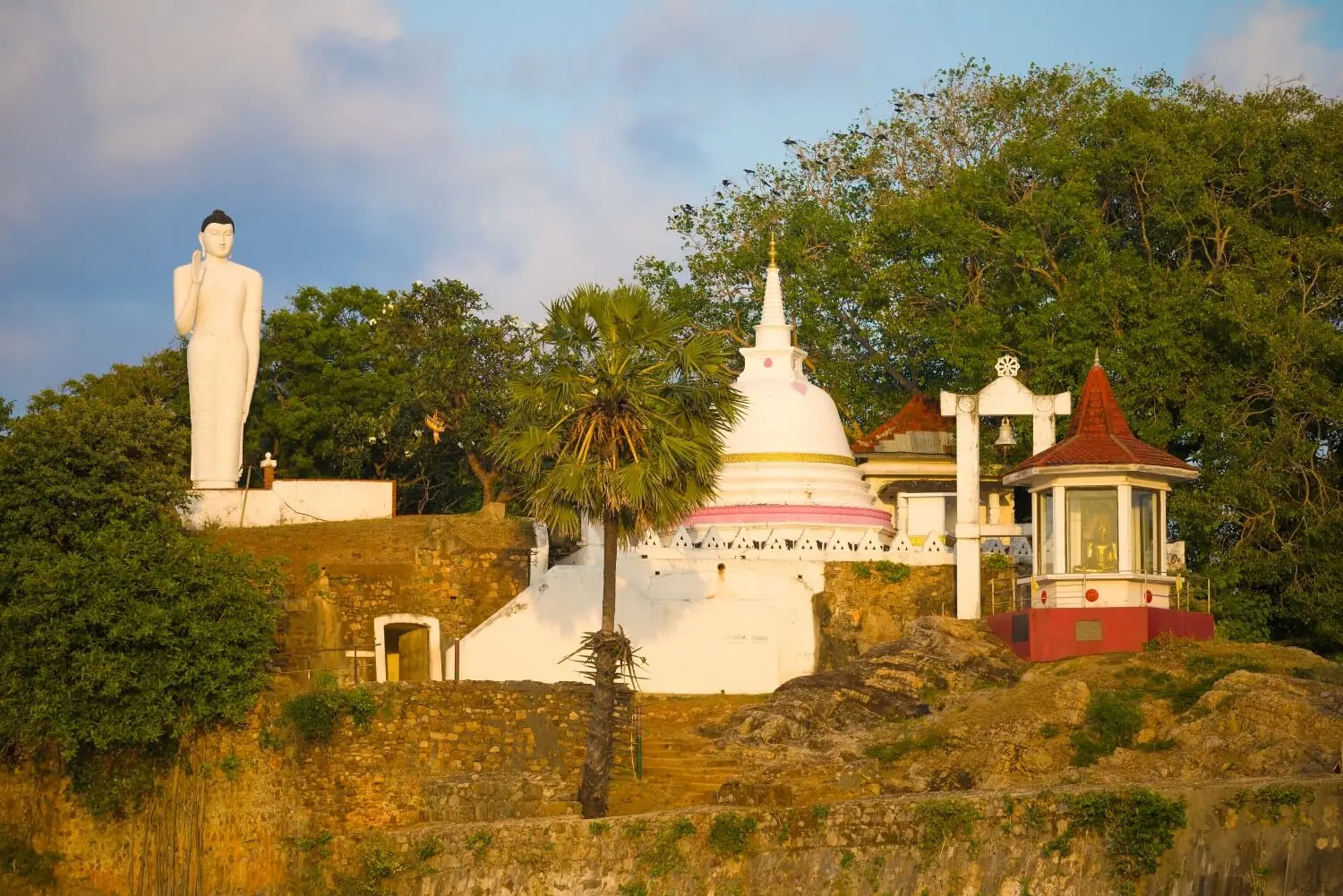
Trincomalee
Ancient temples, colonial forts and maritime history
Discover Trincomalee through its sacred Hindu sites, colonial fortifications, natural harbour and east-coast history, with a practical three-day itinerary connecting Fort Frederick, Koneswaram, the harbour and nearby coastal landmarks.
INTRODUCTION
Welcome to Trincomalee
Trincomalee is one of Sri Lanka’s most historically important port cities, shaped by an exceptional natural harbour, ancient Hindu traditions and centuries of Portuguese, Dutch and British rivalry. Fortifications, temples, naval sites and coastal landmarks reveal a city where religion, trade and maritime strategy have long overlapped.
Two full days cover Trincomalee’s essential historic sights, while a third allows time for Nilaveli, Velgam Vehera or a slower exploration of the harbour and surrounding coast. Staying overnight also makes it easier to visit sacred sites early and enjoy the waterfront in the cooler evening hours.
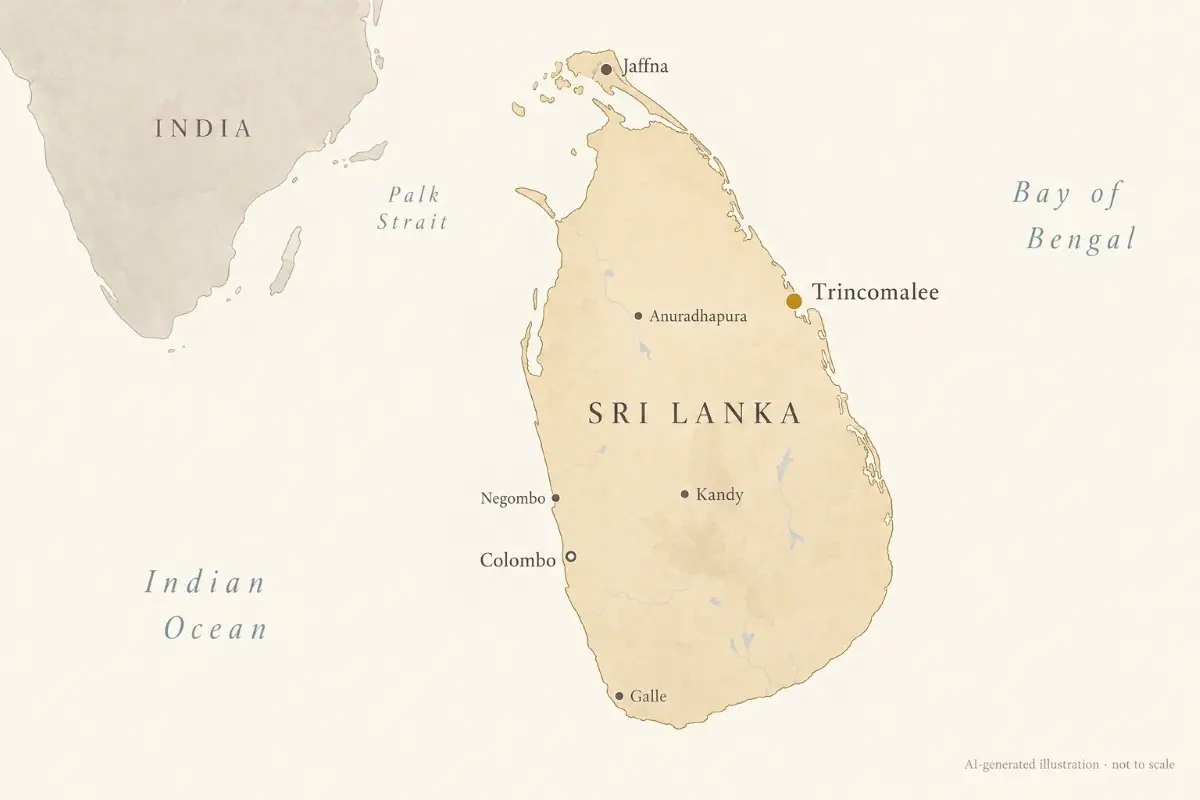
WHY VISIT
Why Visit Trincomalee?
Trincomalee combines ancient Hindu heritage, colonial military history and one of the finest natural harbours in the Indian Ocean. Its temples, forts, naval landscapes and east-coast setting make it one of Sri Lanka’s strongest destinations for maritime and religious history.
01
Koneswaram & Hindu Heritage
Koneswaram Temple stands on Swami Rock and is one of the most important Hindu sacred sites in Sri Lanka. Its long religious history connects Trincomalee with Tamil Saivite traditions and pilgrimage networks across the region.
02
Fort Frederick & Colonial Rule
Fort Frederick preserves the military layers left by Portuguese, Dutch and British rule. The fort’s strategic position above the harbour helps explain why Trincomalee was repeatedly contested by European powers.
03
The Natural Harbour
Trincomalee’s deep natural harbour has shaped the city’s history for centuries. Its strategic value attracted regional traders, colonial powers and naval forces and remains central to the city’s identity.
04
Buddhist & Multi-Religious Heritage
Beyond Koneswaram, Trincomalee also contains Buddhist sites, churches and mosques that reflect the city’s long multicultural history. Nearby Velgam Vehera adds an important ancient Buddhist layer to the region.
HISTORY
A Short History of Trincomalee
Trincomalee’s history is rooted in its harbour and sacred landscape. Koneswaram, associated with ancient Saivite worship, made the area an important religious centre, while the harbour connected Sri Lanka with maritime routes across the Bay of Bengal and Indian Ocean.
The Portuguese occupied Trincomalee in the seventeenth century and built fortifications near the sacred promontory. The Dutch captured the site in 1639 and later rebuilt the fort, while the British took control in 1795 and expanded the harbour’s military importance.
Under British rule, Trincomalee became an important naval base because of its deep and sheltered harbour. The city continued to play a major strategic role during the twentieth century and was also deeply affected by Sri Lanka’s civil conflict before re-emerging as a major cultural and coastal destination.
KEY HISTORICAL MOMENT
1639
In 1639, Dutch forces captured Trincomalee from the Portuguese, beginning a new phase in the city’s colonial history. The Dutch later rebuilt the fortifications that evolved into the site now known as Fort Frederick.
TOP SIGHTS
Top Sights in Trincomalee
These eight sights connect Trincomalee’s Hindu heritage, colonial military history and maritime landscape. Fort Frederick and Koneswaram are essential, but the city becomes far more rewarding when you add the harbour, Buddhist sites and coastal viewpoints.
1
Fort Frederick
Fort Frederick occupies a strategic promontory above Trincomalee harbour. Built and rebuilt by Portuguese, Dutch and British powers, its gates, walls and military layout preserve several centuries of colonial history.
2
Koneswaram Temple
Koneswaram Temple is one of the most important Hindu temples in northern Sri Lanka. The present complex is a major centre of Saivite worship and becomes especially important during the annual Uppuveli festival.
3
Lovers’ Leap & Swami Rock
Lovers’ Leap & Swami Rock is one of the city’s most important civic and cultural landmarks. Rebuilt after its destruction in 1981, it stands as both a centre of learning and a powerful symbol of cultural memory.
4
Trincomalee Harbour
Trincomalee Harbour is one of the largest natural harbours in the world and the central reason for the city’s strategic importance. Viewpoints around the harbour help explain centuries of naval rivalry and maritime trade.
5
Pathirakali Amman Temple
Pathirakali Amman Temple is one of Trincomalee’s most visually striking Hindu temples. Its colourful gopuram and active ritual life provide an important contrast to the more dramatic cliff-top setting of Koneswaram.
6
St Mary’s Cathedral
St Mary’s Cathedral reflects Trincomalee’s long Christian history and the impact of European missionary activity. The church adds another religious layer to a city already shaped by Hindu, Buddhist and Muslim traditions.
7
Velgam Vehera
Velgam Vehera is an ancient Buddhist monastic site north-west of Trincomalee. Its ruins and inscriptions reflect the long interaction of Buddhist and Tamil cultural traditions in the eastern region.
8
Nilaveli & Pigeon Island Coast
Nilaveli and the coast towards Pigeon Island offer a quieter perspective on Trincomalee’s maritime setting. The beaches and offshore islands help explain why the harbour region has always been tied to seafaring and coastal movement.
THINGS TO DO
Things to Do in Trincomalee
Trincomalee works best when sacred sites are combined with its fortifications and harbour. Explore the old fort and Koneswaram first, then add the harbour, local temples and nearby east-coast heritage sites.
Explore Fort Frederick & Swami Rock
Walk through Fort Frederick to Koneswaram and Swami Rock with historical context. The route connects colonial military history, Hindu pilgrimage and dramatic harbour views.
EXPLORE TRINCOMALEE HISTORY TOURS →
Explore Hindu Heritage
Visit Koneswaram and Pathirakali Amman Temple to understand the city’s long Saivite traditions. Respectful dress and attention to local customs are essential at active shrines.
BROWSE TRINCOMALEE CULTURAL TOURS →
Discover the Harbour & Naval History
Visit the Velgam Vehera to add prehistoric and early historic archaeology to your Trincomalee itinerary. The burial site gives a very different perspective on the region before the great Buddhist kingdoms.
DISCOVER TRINCOMALEE HARBOUR TOURS →
Visit Velgam Vehera & Nilaveli
Travel by road and ferry to Nilaveli & Pigeon Island Coast for coral-stone ruins, colonial remains, island temples and a landscape shaped by centuries of maritime contact.
EXPLORE TRINCOMALEE DAY TOURS →
SUGGESTED ITINERARY
3 Days in Trincomalee
Three days allow you to experience Trincomalee beyond the main temple and beach. Use the first day for Fort Frederick and Koneswaram, the second for the harbour and city temples, and the third for Velgam Vehera and Nilaveli.
DAY 1
Fort Frederick, Koneswaram & Swami Rock
MORNING
Begin at Fort Frederick before the heat builds, then walk through the fort to Koneswaram Temple and Swami Rock. Take time to understand how sacred and military history overlap on the same promontory.
AFTERNOON
After lunch, visit Pathirakali Amman Temple and continue through central Trincomalee. Leave time for smaller shrines and colonial-era streets near the harbour.
EVENING
Spend the evening near the waterfront or return to Fort Frederick as the day cools and the harbour light softens.
DAY 2
Harbour, Cathedral & Maritime Trincomalee
MORNING
Start at the Velgam Vehera to explore a much earlier layer of regional archaeology. The site is compact and works well before the strongest midday heat.
AFTERNOON
Spend the afternoon exploring another harbour viewpoint, local markets or the eastern waterfront to understand how the modern city still revolves around the sea.
EVENING
Spend the evening back in central Trincomalee. A slower evening works well after a day focused on the harbour and city streets.
DAY 3
Velgam Vehera, Nilaveli & the Northern Coast
MORNING
Start early for the journey towards Nilaveli & Pigeon Island Coast, allowing time for the road and ferry connection before exploring the island’s historic and religious sites.
AFTERNOON
Continue to Nilaveli in the afternoon for a slower look at the east-coast landscape, or add another nearby heritage stop depending on your route.
EVENING
Return to Trincomalee for a final evening meal and one last walk along the waterfront or through the old fort area.
WHERE TO STAY
Where to Stay in Trincomalee
Trincomalee offers hotels and guesthouses in the city, around Uppuveli and near Nilaveli. Stay in central Trincomalee for history and transport, Uppuveli for beach access, or Nilaveli for a quieter coastal base.
01
Central Trincomalee
Stay in central Trincomalee for the easiest access to Fort Frederick, Koneswaram, the harbour and local transport. This is the most practical choice for a history-focused first visit.
FIND HOTELS IN CENTRAL TRINCOMALEE →
02
Uppuveli
The eastern side of Trincomalee near Lovers’ Leap & Swami Rock offers quieter stays and easy access to the viewpoint and Fort Frederick. It suits travellers who prioritise walking and scenery.
BROWSE STAYS IN UPPUVELI →
03
Nilaveli
Nilaveli is quieter and more resort-oriented, with easy access to the northern coast and Pigeon Island area. It works well for travellers prioritising a slower coastal stay.
FIND STAYS IN NILAVELI →
04
Harbour & Suburban Stays
Guesthouses around the harbour-side suburbs offer a quieter local base with easy tuk-tuk access to the historic centre. They suit travellers who prefer to stay outside the main beach zones.
EXPLORE STAYS AROUND TRINCOMALEE →
GETTING AROUND
Getting Around Trincomalee
Central Trincomalee is compact enough for walking, but Uppuveli, Nilaveli and Velgam Vehera require local transport. Tuk-tuks, buses and private cars are useful depending on the distance.
On Foot
Fort Frederick, Koneswaram, the harbour area and parts of central Trincomalee can be explored on foot. The heat can be intense, so longer walks are easier early or late in the day.
By Bus
Local buses connect Trincomalee with Uppuveli, Nilaveli and other east-coast towns. They are inexpensive, though tuk-tuks are usually easier for individual sights.
By Train
Trincomalee has no railway station. Nilaveli is the nearest useful rail stop, while Trincomalee is the more important regional bus hub; from either place, continue by tuk-tuk, taxi or private transfer.
From Colombo & Bandaranaike International Airport
From Colombo, Trincomalee is usually reached by road via Trincomalee or Nilaveli. Travellers arriving at Bandaranaike International Airport can continue by private transfer, bus connections or a combination of rail and road.
By Tuk-Tuk, Bus & Car
Tuk-tuks are ideal for short city journeys, buses work well for the northern beaches, and a car or driver is useful for Velgam Vehera, Nilaveli and more distant coastal stops.
BEST TIME TO VISIT
Best Time to Visit Trincomalee
Trincomalee is warm year-round, with the northeast monsoon bringing the wettest conditions from roughly October to January. March to August is usually drier and works especially well for combining historical sightseeing with the east-coast beaches.
March–August
DRIER SEASON
March to August is usually the driest and most reliable period for sightseeing, harbour views and coastal excursions, though midday temperatures can be high.
September
HOT & DRY
September is often a transitional month, with conditions still workable but increasing humidity and a greater chance of showers as the monsoon period approaches.
October–February
VARIABLE & WETTER LATE SEASON
October to February is the wetter season, with the highest chance of heavy rain and rougher coastal conditions. Cultural sightseeing remains possible, but outdoor plans need more flexibility.
BEST OVERALL TIME
April–July
April to July usually offers the best balance of dry weather, harbour visibility and good conditions for combining Trincomalee’s historic sites with the coast.
Next Destinations
Anuradhapura
Travel west to Anuradhapura for ancient stupas, Sri Maha Bodhi and one of Sri Lanka’s most important early capitals.
Polonnaruwa
Travel south-west to Polonnaruwa for royal palaces, monumental Buddha images and the history of Sri Lanka’s medieval capital.
EXPLORE POLONNARUWA →
Dambulla
Continue south-west to Dambulla for its UNESCO-listed cave temples, Buddhist murals and sacred rock complex.
EXPLORE DAMBULLA →
Jaffna
Continue north-west to Jaffna for Tamil heritage, Nallur Kandaswamy Kovil and the history of Sri Lanka’s northern peninsula.