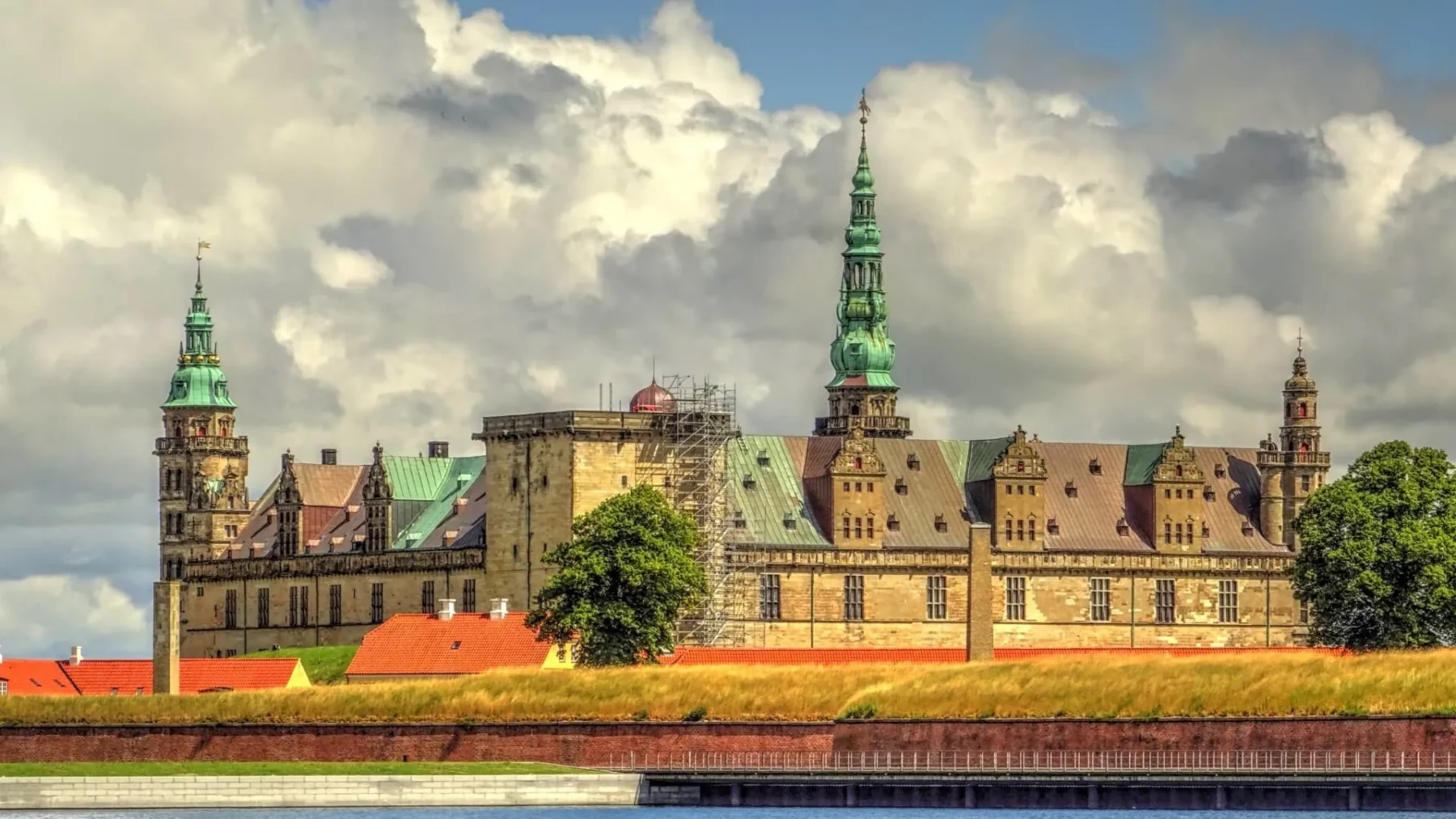
Helsingør
Where Renaissance power, maritime trade and Shakespearean legend meet the Øresund
Discover Helsingør’s Renaissance fortress, medieval streets, maritime museums and shipyard heritage, where centuries of trade through the Øresund shaped one of Denmark’s most international historic towns.
INTRODUCTION
Introduction
Helsingør stands at the narrowest point of the Øresund, the strait separating Denmark from Sweden. Its position on one of northern Europe’s most important sea routes turned a modest medieval settlement into a prosperous port, fortress town and international meeting place.
From 1429 to 1857, ships passing through the Sound were required to pay the Danish Crown’s Sound Dues, bringing merchants, sailors, officials and money into Helsingør. Kronborg Castle guarded the passage, while the old town, churches, ship chandlers and later shipyard preserve the commercial and maritime world that grew around it.
WHY VISIT
Why Visit Helsingør?
Helsingør combines royal power, maritime history and a remarkably preserved historic centre within easy walking distance. Kronborg alone would justify a visit, but the Sound Dues, Carmelite monastery, old merchant streets and shipyard museums reveal a much broader story.
01
Kronborg & the Power of the Sound
Kronborg Castle controlled the narrow gateway between the North Sea and the Baltic. Its bastions, royal apartments and Renaissance halls express the wealth and political leverage Denmark gained from taxing international shipping through the Øresund.
02
A Historic Maritime Trading Town
Helsingør prospered because ships stopped to pay dues, buy provisions, hire pilots and conduct business. Merchant houses, Strandgade, Stengade and the Ship Chandler’s House preserve traces of a town shaped by sailors and merchants from across Europe.
03
Medieval Churches & Monastic Heritage
St. Mary’s Church and the former Carmelite monastery preserve one of the finest medieval monastic ensembles in northern Europe, while St. Olaf’s Cathedral reflects Helsingør’s growth as a wealthy late-medieval and early-modern town.
04
Hamlet & International Cultural Memory
Kronborg became world-famous as Elsinore, the setting of Shakespeare’s Hamlet. The connection is literary rather than evidence that Shakespeare visited the town, but it has given Helsingør a distinctive place in global cultural history.
HISTORY
A Short History of Helsingør
Helsingør developed beside the narrow Øresund crossing between Zealand and Scania. In the early fifteenth century, King Erik of Pomerania strengthened the settlement, granted expanded market-town privileges and built the fortress of Krogen to control passing ships.
The introduction of the Sound Dues in 1429 transformed Helsingør. Ships passing through the strait were required to pay tolls to the Danish Crown, creating work for customs officials, pilots, merchants, craftsmen, innkeepers and ship suppliers. In the 1570s and 1580s, Frederik II rebuilt Krogen as the magnificent Renaissance castle of Kronborg.
Kronborg burned in 1629 and was rebuilt under Christian IV, then captured and looted by Swedish forces in 1658. The Sound Dues ended in 1857, forcing the town to seek a new economic base. Helsingør’s shipyard, founded in 1882, became the dominant industrial employer until its closure in 1983. Kronborg was inscribed on UNESCO’s World Heritage List in 2000.
KEY HISTORICAL MOMENT
1429
In 1429, King Erik of Pomerania introduced the Sound Dues. For more than four centuries, ships passing Helsingør on their way between the North Sea and Baltic were required to pay the Danish Crown, turning the town into a major centre of maritime commerce and customs administration.
TOP SIGHTS
Top Sights in Helsingør
Helsingør’s major historic sights cluster between Kronborg and the old town. Together they trace royal power, Sound Dues commerce, medieval religion, industrial shipbuilding and the maritime culture created by centuries of international traffic through the Øresund.
1
Kronborg Castle
Built by Frederik II between 1574 and 1585 on the site of the earlier fortress Krogen, Kronborg is one of northern Europe’s great Renaissance castles. Explore royal apartments, the Great Hall, chapel, casemates and powerful bastion system overlooking the Øresund.
2
M/S Maritime Museum of Denmark
Built underground around a former dry dock beside Kronborg, the national maritime museum explores Denmark’s relationship with global shipping, trade and seafaring. Its setting within the former shipyard landscape connects modern museum architecture with Helsingør’s industrial past.
3
St. Mary’s Church & Carmelite Monastery
Founded in the fifteenth century, the Carmelite complex is among the best-preserved medieval monasteries in northern Europe. St. Mary’s Church, cloisters and monastic spaces preserve Helsingør’s religious world before the Reformation.
4
St. Olaf’s Cathedral
The Gothic St. Olaf’s Cathedral forms the spiritual counterpart to the castle across the river. Begun in the fifteenth century, it reflects the wealth of the medieval town and the close relationship between local religious institutions and noble patrons.
5
Stengade, Axeltorv & the Old Town
Stengade remains the historic spine of Helsingør, lined with merchant houses and later urban architecture. Nearby lanes, Axeltorv and streets running towards the former waterfront reveal the medieval plan of a town built around international commerce.
6
Skibsklarerergaarden – Ship Chandler’s House
This preserved merchant and ship-chandler property on Strandgade evokes the era when vessels stopped in Helsingør to handle customs formalities and buy supplies. Historic rooms and commercial interiors make the Sound Dues economy unusually tangible.
7
Helsingør Shipyard Museum
The shipyard founded in 1882 reshaped Helsingør after the abolition of the Sound Dues. The museum preserves workers’ stories, tools, industrial traditions and the social history of the yard that dominated local employment for a century.
8
Helsingør City Museum
The city museum introduces more than six centuries of local history, from medieval growth and the Sound Dues to industrialisation and twentieth-century Helsingør. It is a useful companion to the individual monuments encountered around town.
THINGS TO DO
Things to Do in Helsingør
Helsingør is compact enough to explore on foot, but its story extends from Renaissance court life to merchant culture and industrial shipbuilding. Guided tours and museum visits help connect Kronborg with the working port and historic streets beyond its walls.
Explore Kronborg Castle
Walk through the royal apartments, Great Hall, chapel and fortifications of Kronborg. A guided visit helps explain how the castle combined royal residence, military power and the administration of the Sound Dues at the gateway to the Baltic.
EXPLORE KRONBORG TOURS →
Walk the Sound Dues Old Town
Follow Stengade, Strandgade and the lanes between the old waterfront and market streets. Merchant houses, churches and the Ship Chandler’s House reveal how international shipping shaped daily life in Helsingør.
EXPLORE HELSINGØR HISTORY WALKS →
Discover Helsingør’s Maritime Heritage
Combine the M/S Maritime Museum of Denmark with the Shipyard Museum and Culture Harbour. Together they trace the transition from sailing ships and global trade to industrial shipbuilding and the redevelopment of the former yard.
EXPLORE MARITIME MUSEUMS →
Trace Hamlet in Elsinore
Explore the literary connection between Kronborg and Shakespeare’s Hamlet. The play made Elsinore famous worldwide, and seasonal performances and interpretive experiences add a cultural layer to the castle’s documented political and maritime history.
EXPLORE HAMLET & KRONBORG →
SUGGESTED ITINERARY
3 Days in Helsingør
Three days allow time to explore Kronborg in depth, walk the Sound Dues town, visit Helsingør’s maritime museums and experience the Øresund landscape without reducing the city to a quick castle excursion from Copenhagen.
DAY 1
Kronborg, Hamlet & the Øresund
MORNING
Begin at Kronborg Castle before the busiest part of the day. Explore the royal rooms, Great Hall and chapel, then walk the ramparts to understand why this narrow point of the Øresund was so strategically valuable.
AFTERNOON
Continue through the casemates and outer fortifications before walking around the Culture Harbour. Visit the M/S Maritime Museum of Denmark, whose underground galleries sit in a former shipyard dry dock.
EVENING
Return to Kronborg’s waterfront at dusk and look across the strait towards Helsingborg. The view makes the geography behind the Sound Dues immediately clear and gives a strong sense of Helsingør’s position between Denmark, Sweden and the Baltic.
DAY 2
The Sound Dues Town
MORNING
Begin at St. Mary’s Church and the Carmelite monastery before continuing into the old town. Walk Stengade and the surrounding lanes, paying attention to the medieval street plan and surviving merchant houses.
AFTERNOON
Visit St. Olaf’s Cathedral and continue towards Strandgade for the Ship Chandler’s House. Its rooms and commercial spaces provide one of the clearest introductions to the everyday economy created by the Sound Dues.
EVENING
Visit Helsingør City Museum in the late afternoon, then spend a relaxed evening in the old town. The preserved photographic studio adds an unusually personal twentieth-century layer to the medieval setting.
DAY 3
Shipyard History & the Cross-Sound Landscape
MORNING
Start at the Helsingør Shipyard Museum and explore the former industrial district around the Culture Yard. The shipyard’s history shows how Helsingør reinvented itself after the Sound Dues ended in the nineteenth century.
AFTERNOON
Take the short ferry across the Øresund to Helsingborg in Sweden. From the water, Kronborg’s strategic position becomes even more obvious, while Helsingborg adds another perspective on the historic crossing between Zealand and Scania.
EVENING
Return to Helsingør for a final harbour and old-town walk. After three days, the relationship between royal fortress, customs town, industrial shipyard and modern cultural harbour becomes much easier to read.
WHERE TO STAY
Where to Stay in Helsingør
Helsingør is compact and its main historical sights are walkable from the centre. Staying near Stengade, the harbour or the railway station makes it easy to reach Kronborg early and enjoy the old town after day-trippers return to Copenhagen.
01
Historic Centre & Stengade
The most atmospheric choice, placing you among merchant streets, churches, cafés and historic houses. Kronborg and the harbour remain within an easy walk, making this the best base for a history-focused stay.
FIND HOTELS IN CENTRAL HELSINGØR →
02
Kronborg & Culture Harbour
Kronborg & Culture Harbour lies immediately below the castle and is ideal for travellers focused on the chateau, monasteries and historic houses north of the river. It is quieter than the central square but still within easy walking distance of everything.
FIND STAYS NEAR KRONBORG →
03
Station & Ferry Terminal
South of the historic core, Station & Ferry Terminal offers a quieter local atmosphere while remaining within walking distance of the old town. It is a good choice for travellers who prefer calm evenings and traditional streets away from the busiest centre.
BROWSE STAYS NEAR HELSINGØR STATION →
04
Snekkersten
South of Helsingør, Snekkersten offers a quieter coastal base with train connections into the centre. It works well for travellers who prefer seaside surroundings while remaining within easy reach of Kronborg and the old town.
FIND STAYS IN SNEKKERSTEN →
GETTING AROUND
Getting Around Helsingør
Helsingør is straightforward to explore without a car. Kronborg, the old town, station, ferry terminal and major museums are all close together, while regional trains and buses connect the city with Copenhagen and northern Zealand.
On Foot
Walking is the default way to explore the castle, Kronborg & Culture Harbour and the old town. Expect cobbled streets, stairs and slopes, particularly around the castle complex and viewpoints above the Øresund.
By Local Bus & Bicycle
Frequent regional trains connect Helsingør with Copenhagen along the coast. The station sits beside the old town and ferry terminal, making rail the simplest way to arrive for most visitors.
By Ferry
Passenger and vehicle ferries cross the Øresund between Helsingør and Helsingborg in Sweden throughout the day. The short crossing is useful both for onward travel and for experiencing the narrow strait that shaped the city’s history.
By Local Bus & Bicycle
Local buses are useful for outer neighbourhoods and nearby coastal destinations. Cycling is also practical along the relatively flat waterfront and on routes south towards Snekkersten and Humlebæk.
By Car
A car is unnecessary for central Helsingør and can be inconvenient around the busiest heritage areas. It becomes more useful for combining the city with castles, coastal villages and countryside elsewhere in North Zealand.
BEST TIME TO VISIT
Best Time to Visit Helsingør
Helsingør can be visited year-round, but late spring and early autumn offer the best balance of mild weather, long daylight and comfortable walking conditions. Summer is lively and well suited to waterfront exploration, while winter is quieter and more atmospheric inside museums and historic churches.
Spring
MARCH TO MAY
Spring brings longer days, milder temperatures and good conditions for walking between Kronborg and the old town. May is especially pleasant, with more reliable daylight and fewer visitors than the busiest summer weeks.
Summer
JUNE TO AUGUST
Summer offers very long daylight hours and the fullest programme of castle events, harbour activity and seasonal Hamlet experiences. It is also the busiest period, so early morning visits to Kronborg are worthwhile.
Autumn & Winter
SEPTEMBER TO FEBRUARY
Early autumn remains excellent for walking, with cooler air and fewer crowds. Winter is colder, darker and windier along the Øresund, but museums, churches and the old town are significantly quieter and the maritime setting can be especially atmospheric.
BEST OVERALL TIME
May to June & September
Late spring and early autumn provide comfortable temperatures, generous daylight and fewer crowds than peak July and August. These months are particularly good for combining Kronborg interiors with long walks through the old town and harbour.