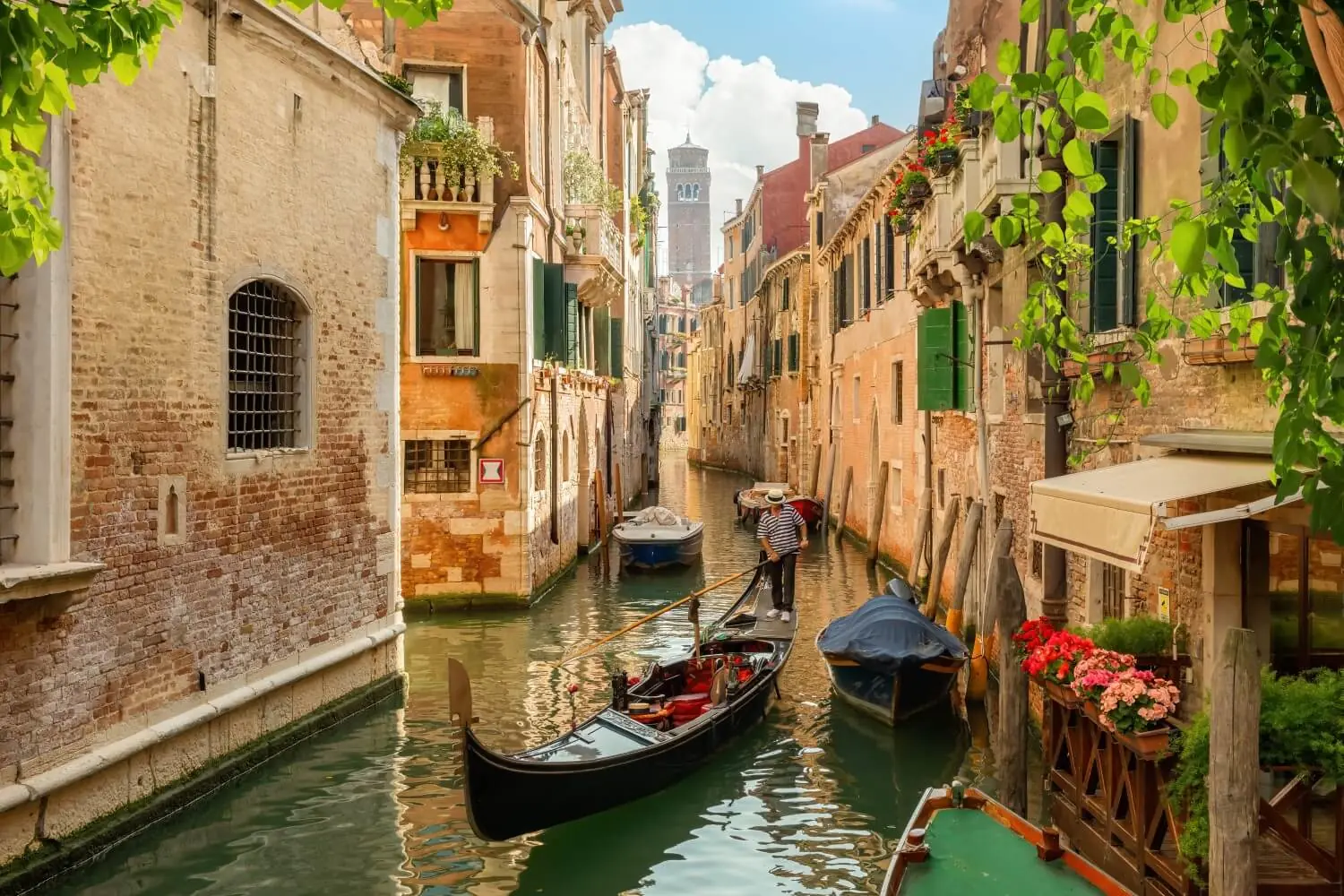
Venice
Maritime empire, Byzantine splendour and lagoon history
Discover Venice through the palaces, churches, trading districts and waterways of the former Venetian Republic, with a practical three-day itinerary connecting St Mark’s, Rialto, Venetian art and the wider lagoon.
INTRODUCTION
Introduction
Venice grew from scattered lagoon settlements into one of the most powerful maritime republics of medieval and early modern Europe. Its political institutions, commercial networks and unusual relationship with the water shaped a city of palaces, churches, warehouses, bridges and public spaces unlike anywhere else in Italy.
Three full days give a strong first introduction, while four or five allow more time for art, the Jewish Ghetto and the islands of the lagoon. Reserve St Mark’s and the Doge’s Palace around your priorities, then leave space to walk slowly through quieter calli, campi and waterfront districts.
WHY VISIT
Why Visit Venice?
Venice is more than a beautiful city built on water. Its monuments preserve the history of a republic that connected Europe with the eastern Mediterranean and developed a distinctive political, artistic and maritime culture over many centuries.
01
The Maritime Republic
The Doge’s Palace, Arsenal and waterfront reveal the institutions and infrastructure behind the Venetian Republic. Venice’s wealth depended on shipping, diplomacy and commercial networks stretching across the Adriatic and eastern Mediterranean.
02
St Mark’s & Byzantine Venice
St Mark’s Basilica reflects Venice’s deep connections with Byzantium through its domes, mosaics, imported marbles and precious objects. The arrival of Saint Mark’s relics in 829 also gave the republic a powerful patron and civic identity.
03
Venetian Art in Context
Bellini, Titian, Tintoretto, Veronese and other Venetian artists worked for churches, confraternities and government institutions. Museums and original interiors let you see their work in the civic and religious settings that shaped it.
04
The Lagoon as a Historical Landscape
Venice cannot be understood without its lagoon. Murano, Burano and especially Torcello reveal different chapters in settlement, craftsmanship and maritime life, while the waterways themselves explain how the city survived and prospered.
HISTORY
A Short History of Venice
Permanent settlement in the Venetian lagoon developed from late antiquity, with communities using islands as refuges and trading points during the upheavals that followed the western Roman Empire. By the early Middle Ages, political power increasingly centred on the Rialto islands, and Venice emerged from the Byzantine world as an increasingly autonomous maritime city.
By the tenth century Venice had become a major trading power. The republic expanded its commercial reach through the Adriatic and eastern Mediterranean, while the doge, councils and merchant elite developed an unusually durable political system. The Fourth Crusade of 1204 greatly increased Venetian influence and brought wealth, territory and artworks from Constantinople, while rivalry with Genoa and later the Ottoman Empire shaped its maritime ambitions.
Changing trade routes, Ottoman expansion and repeated wars reduced Venice’s dominance, yet the city remained a major centre of art, publishing, diplomacy and luxury production. Napoleon ended the Republic in 1797. After periods of French and Austrian rule, Venice joined the Kingdom of Italy in 1866, and Venice and its Lagoon were inscribed on the UNESCO World Heritage List in 1987.
KEY HISTORICAL MOMENT
1204
In 1204, forces of the Fourth Crusade captured and sacked Constantinople with major Venetian involvement. Venice gained commercial advantages and territories, while marbles, relics and artworks were brought west, including objects later incorporated into St Mark’s Basilica. The episode strengthened Venice’s Mediterranean power but came at immense cost to the Byzantine capital.
TOP SIGHTS
Top Sights in Venice
These eight sights connect Venice’s political, religious, commercial and artistic history. St Mark’s and the Doge’s Palace deserve reserved time, while the remaining places are best linked through neighbourhood walks rather than treated as isolated attractions.
1
St Mark’s Basilica
The present basilica was begun in 1063 and consecrated in 1094, replacing earlier churches built for the relics of Saint Mark. Its mosaics, domes, Pala d’Oro and imported materials embody Venice’s relationship with Byzantium and the wider Mediterranean. Check current entry and reservation arrangements before visiting.
2
Doge’s Palace
The Palazzo Ducale was the residence of the doge and the centre of government for the Venetian Republic. Its Gothic façades conceal council chambers, courts, armouries and prisons, revealing how Venice combined ceremony with a complex political system. The present palace developed mainly between the fourteenth and sixteenth centuries.
3
Rialto Bridge & Market
Rialto was Venice’s commercial heart long before the present stone bridge was completed in 1591. Walk through the market area and across the Grand Canal to understand the relationship between trade, finance, food supply and the waterways that sustained the republic.
4
Gallerie dell’Accademia
The Accademia holds the world’s most important collection of Venetian and Veneto painting. Bellini, Giorgione, Titian, Tintoretto, Veronese and other masters make the museum essential for understanding how Venetian art developed from the late Middle Ages through the eighteenth century.
5
Scuola Grande di San Rocco
Founded as a confraternity in 1478, San Rocco became one of Venice’s richest scuole and preserves an extraordinary cycle by Tintoretto in its original setting. The building shows how lay religious organisations combined charity, devotion, civic identity and artistic patronage.
6
Basilica di Santa Maria Gloriosa dei Frari
The Frari is one of Venice’s great Gothic churches and an exceptional place to see art in its religious setting. Titian’s Assumption dominates the high altar, while monuments, chapels and tombs connect the church with leading families and artists of the republic.
7
The Jewish Ghetto
In 1516, the Venetian Senate required the city’s Jewish residents to live in the Ghetto Nuovo in Cannaregio. Synagogues, tall residential buildings and the surrounding streets preserve the history of a community shaped by both restriction and international connections.
8
Arsenal & Naval History Museum
The vast Arsenal supplied ships, weapons and equipment to the Venetian state and became one of Europe’s most remarkable pre-industrial production complexes. The nearby Naval History Museum adds ship models, maritime objects and context for the republic’s naval power.
THINGS TO DO
Things to Do in Venice
Venice works best when you follow its history through neighbourhoods and waterways. Combine major monuments with experiences that explain the republic’s institutions, artistic culture and relationship with the lagoon rather than filling every hour with separate attractions.
Walk Through the Republic’s Political Heart
Join a history-focused walk around St Mark’s Square, the Doge’s Palace and the waterfront to understand how government, ceremony, trade and religion overlapped in the centre of the republic. A good guide makes the institutions behind the famous façades much easier to read.
EXPLORE VENICE HISTORY TOURS →
Discover Venetian Art in Its Original Setting
Pair the Accademia with the Frari or Scuola Grande di San Rocco to see how paintings functioned within churches and confraternities. Guided art walks can connect artists, patrons and neighbourhoods rather than reducing Venetian painting to a list of masterpieces.
BROWSE VENICE ART TOURS & TICKETS →
Explore Cannaregio & the Jewish Ghetto
Walk through Cannaregio to the historic Ghetto, then continue along quieter canals and campi away from the main route to St Mark’s. The district adds Jewish history, residential Venice and an important perspective on how different communities lived within the republic.
DISCOVER CANNAREGIO WALKS →
Cross the Lagoon to the Historic Islands
Use the vaporetto network to explore Murano’s glassmaking heritage, Burano’s island community and Torcello’s early religious landscape. Choose two islands for a relaxed day or focus on Torcello if the origins of settlement in the lagoon are your priority.
EXPLORE VENICE LAGOON TOURS →
SUGGESTED ITINERARY
3 Days in Venice
Three days are enough for the essential historic layers if you organise the city by district. Reserve St Mark’s and the Doge’s Palace first, then keep the second day for art and trading districts and the third for the lagoon islands.
DAY 1
St Mark’s & the Venetian Republic
MORNING
Begin early in St Mark’s Square and visit the basilica at your reserved or chosen time. Study the mosaics, imported marbles and eastern influences before exploring the square itself as the ceremonial centre of Venice.
AFTERNOON
After lunch, spend several hours in the Doge’s Palace. Follow the route through the state rooms, institutional chambers, Bridge of Sighs and prisons, allowing the building to explain how the republic actually governed itself.
EVENING
Walk east along the Riva degli Schiavoni into Castello. The waterfront once connected Venice with sailors, merchants and territories across the Adriatic, and an evening away from the busiest square reveals a more residential side of the city.
DAY 2
Rialto, Venetian Art & Dorsoduro
MORNING
Start around Rialto before the central routes become busiest. Explore the market area and bridge, then walk through San Polo towards the Frari and Scuola Grande di San Rocco for Gothic architecture and Tintoretto’s great decorative cycle.
AFTERNOON
Cross towards the Accademia and spend the afternoon with Venetian painting. Afterwards, walk through Dorsoduro towards the Zattere or Punta della Dogana rather than adding another major museum.
EVENING
Finish beside the Giudecca Canal or walk north towards Cannaregio for dinner. A slower evening through residential streets helps balance a day dominated by churches and collections.
DAY 3
The Lagoon Islands
MORNING
Travel first to Murano for the island’s glassmaking history and quieter canals. Visit a museum or workshop if the craft interests you, but leave enough time for the northern lagoon rather than spending the entire day shopping.
AFTERNOON
Continue to Burano and Torcello. Burano offers a living island community and lace tradition, while Torcello’s cathedral and early settlement history provide the strongest connection with the lagoon before Venice became the dominant centre.
EVENING
Return to Venice for a final evening walk through Cannaregio, Castello or the streets around your accommodation. Venice is especially rewarding after day visitors leave and the relationship between canals, bridges and neighbourhood life becomes quieter.
WHERE TO STAY
Where to Stay in Venice
Where you stay affects how Venice feels. The historic city is walkable but bridges, steps and luggage can make transfers slow, so balance atmosphere with proximity to a vaporetto stop or Santa Lucia station.
01
San Marco & the Historic Core
Stay near St Mark’s for immediate access to the basilica, Doge’s Palace and central landmarks. It is the most convenient area for first-time sightseeing, but accommodation is often expensive and the principal routes remain busy for much of the day.
FIND HOTELS IN SAN MARCO →
02
Dorsoduro
Dorsoduro suits travellers who want art, churches and a calmer evening atmosphere while remaining within walking distance of the historic centre. The Accademia, Zattere and several important museums make it especially good for a slower cultural stay.
BROWSE STAYS IN DORSODURO →
03
Cannaregio
Cannaregio combines convenient access to Venezia Santa Lucia station with the Jewish Ghetto, residential canals and excellent evening walks. Stay away from the busiest station route if you want the district’s quieter character.
FIND STAYS IN CANNAREGIO →
04
Castello
Castello stretches east from St Mark’s towards the Arsenal and offers a mix of monumental sights and local streets. It works well for travellers interested in maritime history or a quieter base that still keeps central Venice within walking distance.
EXPLORE CASTELLO HOTELS →
GETTING AROUND
Getting Around Venice
Venice is a pedestrian city supported by water transport. Walking is usually the best way to explore individual districts, while vaporetti connect the Grand Canal, outer stops and lagoon islands. Access-fee rules for day visitors can change by year, so check the official Venice website before travelling.
On Foot
Most historic sights are reached on foot through narrow calli, campi and bridges. Distances can feel longer than they look because routes rarely run straight, and steps make heavy luggage difficult. Comfortable shoes and a relaxed schedule are more useful than trying to optimise every turn.
By Vaporetto
ACTV waterbuses are Venice’s main public transport system and are useful for the Grand Canal, Giudecca, Lido and lagoon islands. Validate or activate the correct ticket before travel and check the current route because lines and stopping patterns can vary.
By Train
Venezia Santa Lucia station opens directly onto the historic city, making rail one of the easiest ways to arrive. High-speed and regional trains connect Venice with Padua, Verona, Bologna, Florence, Milan and other Italian cities.
From Marco Polo & Treviso Airports
Marco Polo Airport has bus connections to Piazzale Roma and water services towards Venice. Treviso Airport relies mainly on road transfers towards Venice and Mestre. Compare the full route to your accommodation, because the final journey may still require a vaporetto or walk over bridges.
By Water Taxi, Traghetto & Car
Private water taxis offer direct but expensive transfers where landing points allow. Traghetto gondolas provide simple daytime crossings of the Grand Canal at selected points. Cars cannot enter historic Venice; drivers must leave them at Piazzale Roma, Tronchetto or on the mainland.
BEST TIME TO VISIT
Best Time to Visit Venice
Spring and early autumn usually provide the best balance for long walks, lagoon travel and outdoor architecture. Venice remains popular throughout the year, and major events, Carnival and cruise or holiday periods can change visitor levels dramatically.
Spring
MARCH TO MAY
Spring brings mild conditions and longer days for exploring on foot. Easter and public holidays can be busy, while changeable weather makes a light waterproof useful. May is particularly good for combining the city with longer trips across the lagoon.
Summer
JUNE TO AUGUST
Summer is hot, humid and often crowded on the main routes between Rialto and St Mark’s. Start major sights early, use churches and museums during the warmest hours and spend evenings in quieter districts or beside the lagoon.
Autumn & Winter
SEPTEMBER TO FEBRUARY
Early autumn can be excellent for walking, while later autumn and winter bring cooler weather, shorter days and a greater possibility of high-water events. Winter can feel wonderfully atmospheric outside holiday and Carnival periods, especially for museum-focused visits.
BEST OVERALL TIME
Late April–May & late September–October
These periods usually offer comfortable temperatures for combining monuments, long walks and lagoon excursions. They are still popular seasons, so choose accommodation early and use timed reservations where available rather than expecting an empty city.