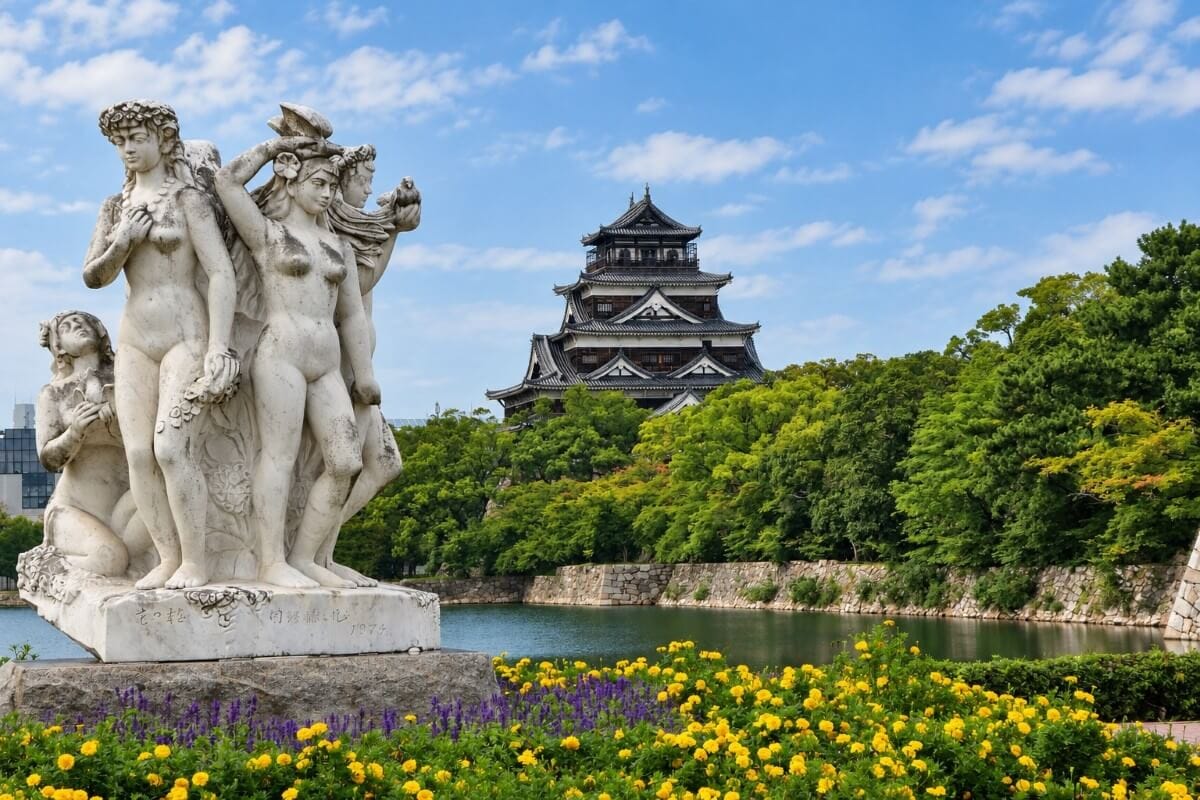
Hiroshima is one of Japan’s most historically significant cities, with a story extending far beyond the events of 1945. The modern city developed around a powerful samurai castle founded during Japan’s turbulent unification period. Centuries later, Hiroshima became the first city attacked with an atomic bomb during warfare. That tragedy reshaped both the city and its international identity.
Today, a Hiroshima historical travel guide combines samurai heritage, wartime history, peaceful gardens and remarkable post-war reconstruction. The UNESCO-listed Atomic Bomb Dome remains its most recognised monument and one of the world’s strongest symbols of peace. Yet Hiroshima also rewards visitors with temples, regional cuisine, sake traditions and easy access to historic Miyajima.

A Little Bit of History
Hiroshima’s recorded urban history began during the late sixteenth century, when powerful lord Mori Terumoto established a castle on the Ota River delta. Construction of Hiroshima Castle began in 1589, creating the political centre around which the city developed. The location offered access to the Seto Inland Sea and valuable regional trade routes. After the Battle of Sekigahara in 1600, Mori Terumoto lost much of his territory following Tokugawa Ieyasu’s victory.
Fukushima Masanori briefly controlled Hiroshima before the Asano family received the domain in 1619. The Asano governed Hiroshima throughout most of the Edo period under the Tokugawa shogunate. Merchants and artisans settled around the castle, turning the district into an important regional city. Shukkeien Garden, created in 1620, reflected the refined culture that developed alongside Hiroshima’s political importance.
The Meiji Restoration of 1868 ended feudal rule and transformed Hiroshima into an increasingly modern administrative and military centre. Hiroshima officially became a city in 1889 as railways, industry and military facilities expanded. During the First Sino-Japanese War of 1894–1895, the Imperial General Headquarters temporarily operated from Hiroshima. The city remained strategically important during the following decades and the Second World War. On 6 August 1945, an American B-29 dropped an atomic bomb over Hiroshima at 8:15 in the morning.
Vast areas were destroyed, while tens of thousands died immediately and many more later from injuries and radiation. Reconstruction accelerated after the 1949 Hiroshima Peace Memorial City Construction Law encouraged the city’s transformation into an international centre for peace. The Atomic Bomb Dome entered the UNESCO World Heritage List in 1996, preserving one surviving structure near the hypocentre for future generations.

Best Time to Visit Hiroshima
Spring and autumn provide the best weather for exploring historic Hiroshima on foot. March to May brings mild temperatures, cherry blossoms and increasingly busy sightseeing areas during Japan’s spring travel season. April is especially attractive, although hotels and major attractions can become crowded. October and November offer comfortable temperatures, autumn colours and good conditions for excursions to Miyajima.
Summers are hot and humid, with the rainy season generally affecting June and early July. Hiroshima holds its Peace Memorial Ceremony every 6 August, creating a solemn period of remembrance around Peace Memorial Park. Winter is cooler and quieter, making December through February suitable for travellers who prefer lighter crowds.
How Many Days Do You Need in Hiroshima?
Two full days provide a good introduction to Hiroshima, while three days allow visitors to explore its wider historical landscape. A one-day visit can combine Peace Memorial Park, the Atomic Bomb Dome, Hiroshima Castle and Shukkeien Garden. Travellers should allow several hours for the Peace Memorial Museum because its exhibitions deserve unhurried attention. With two days, visitors can explore neighbourhoods, temples and Hiroshima’s traditional food culture more comfortably.
A third day is ideal for Miyajima, home to UNESCO-listed Itsukushima Shrine and centuries of religious heritage. Iwakuni is another worthwhile excursion, particularly for its historic Kintai Bridge and former castle-town atmosphere. Saijo also makes an excellent half-day trip for travellers interested in Hiroshima Prefecture’s renowned sake traditions.

Accommodation in Hiroshima
The most convenient area to stay is central Hiroshima between Hiroshima Station, Hatchobori and Peace Memorial Park. Hatchobori places visitors close to restaurants, trams, shopping streets and several historical attractions. The Peace Park area offers quieter evenings and excellent access to the city’s most important memorial sites. Staying near Hiroshima Station is better for travellers planning early Shinkansen departures or day trips.
Budget business hotels are widely available, while several established international hotels serve mid-range and luxury travellers. Rates vary considerably during weekends, cherry blossom season and major Japanese holidays. Current summer prices suggest the following amounts are reasonable starting estimates for standard double rooms, although individual nights can differ substantially.
Some Tips & Ideas for Hotels Include:
Hotel Granvia – This established hotel sits directly beside Hiroshima Station. It provides excellent access to Shinkansen services and regional trains. Prices from approximately €55 per night.
RIHGA Royal Hotel – A long-established upscale choice near Hiroshima Castle and central attractions. Higher floors provide broad city views. Prices from approximately €65 per night.
Mitsui Garden Hotel – A dependable mid-range property between the station and Peace Memorial Park. Its location works well for sightseeing on foot. Prices from approximately €60 per night.
Hotel Intergate Hiroshima – A comfortable modern hotel near Hatchobori and tram connections. It offers strong value for history-focused city breaks. Prices from approximately €55 per night.
Book your preferred hotel, apartment, or hostel here.

Sightseeing in Hiroshima
Hiroshima’s historical attractions tell a story of feudal government, wartime destruction and determined reconstruction. Peace Memorial Park naturally forms the emotional centre of most visits. Yet the city also preserves evidence of the centuries that preceded the atomic bombing. Castle remains, traditional gardens and temples reveal Hiroshima’s importance during the Edo period and earlier.
Several surviving trees and structures also provide physical connections with the events of 1945. Hiroshima Castle itself was destroyed in the bombing, while the present main keep was reconstructed in 1958. Visiting these sites together prevents Hiroshima’s complex history from being reduced to a single moment.
Below are some of the country’s most interesting historical attractions.
Atomic Bomb Dome – This UNESCO World Heritage Site survived near the hypocentre of the 1945 explosion and remains a globally recognised peace memorial.
Hiroshima Peace Memorial Museum and Park – The museum documents the atomic bombing, its victims and its aftermath within a park dedicated to lasting peace.
Hiroshima Castle – Originally begun in 1589, the castle established the political centre around which Hiroshima developed. The present keep dates from 1958.
Shukkeien Garden – Created in 1620, this traditional landscape garden reflects the refined culture of Hiroshima’s feudal rulers and survived severe wartime damage.
Fudoin Temple – This historic Buddhist temple contains architecture predating the atomic bombing, including structures connected with medieval and early modern Hiroshima.
Looking for exciting tours and activities? Book them here through GetYourGuide.

Food & Drinks – Taste the Local Cuisine
Hiroshima has one of Japan’s strongest regional food identities, shaped by the Seto Inland Sea and the city’s post-war recovery. Hiroshima-style okonomiyaki layers batter, cabbage, pork, noodles and egg rather than mixing everything together. Its modern form developed strongly after 1945, when inexpensive ingredients helped residents create filling meals during reconstruction. Mitchan Sohonten, founded in 1950, became closely associated with techniques now considered standard in Hiroshima-style okonomiyaki.
Oysters are another regional speciality, commonly grilled, fried or served in hotpots during the cooler months. Hiroshima Prefecture also produces excellent sake, particularly around nearby Saijo, alongside citrus products and Seto Inland Sea seafood. Craft breweries and contemporary wine bars now complement these older culinary traditions.
Here are some restaurant ideas and recommendations:
Mitchan Sohonten Hatchobori – Founded in 1950, this famous restaurant played an important role in developing modern Hiroshima-style okonomiyaki. Expect queues during busy periods.
Nagataya – A popular okonomiyaki specialist near Peace Memorial Park. It is especially convenient for first-time visitors exploring central Hiroshima.
Kanawa – A long-established name associated with Hiroshima oysters and Seto Inland Sea seafood. Its oyster dishes showcase one of the region’s defining ingredients.
Restaurant HIROTO – An acclaimed French-influenced restaurant recognised in previous Michelin editions covering Hiroshima. Current Michelin coverage of Hiroshima is not active.
Hiroshima Neighborly Brewing – This central craft brewery produces beers using seasonal Hiroshima ingredients. It operates close to Peace Memorial Park.

How to Get there?
Flights
International travellers most commonly reach Hiroshima through Hiroshima Airport or major international airports elsewhere in Japan. Hiroshima Airport handles several international and domestic routes, although its location is outside the central city. The airport limousine bus reaches Hiroshima Station in approximately 45 to 50 minutes under normal conditions. Buses also serve Hiroshima Bus Center in roughly 55 minutes, providing convenient access to the Peace Park area.
Travellers arriving through Tokyo, Osaka or Fukuoka can usually continue efficiently by Shinkansen. Kansai International Airport is particularly useful for travellers combining Hiroshima with Osaka, Kyoto or Kobe. Visitors should allow additional time during busy road periods because airport buses can encounter traffic.
Looking for flights? Book your tickets here through Skyscanner.
Public Transport
Rail is the easiest way to reach Hiroshima from most major Japanese cities. The Sanyo Shinkansen connects Hiroshima directly with Shin-Osaka, Kobe, Himeji, Okayama, Fukuoka and other cities. Journeys from Shin-Osaka usually take around 80 to 90 minutes on the fastest services. From Hakata in Fukuoka, high-speed trains generally take about one hour.
Tokyo to Hiroshima takes roughly four hours on direct Shinkansen services. Hiroshima Station lies about 15 to 25 minutes from Peace Memorial Park by tram or bus, depending on traffic. Japan has no international passenger railway from neighbouring countries, so overseas visitors must first arrive by air or sea.
Looking for public transport tickets? Book your bus tickets here through Busbud
Car Rental
Renting a car is unnecessary for travellers focusing on central Hiroshima and Miyajima. Trams, buses and trains connect the main historical attractions efficiently, while many central sights are within walking distance. A car becomes more useful for exploring rural Hiroshima Prefecture, mountain districts and smaller coastal communities. Rental companies operate at Hiroshima Airport and around Hiroshima Station.
Driving from Hiroshima Airport to the city centre usually takes around 45 to 60 minutes when traffic is light. Parking in central districts adds costs and can be inconvenient near major sightseeing areas. Travellers following the classic Osaka, Himeji, Hiroshima and Fukuoka route will normally find rail faster and simpler.
Would you like to rent a car in Japan? Book your all-inclusive rental here with DiscoverCars.
Do you have any tips, comments, or suggestions for this travel guide about Hiroshima? Feel free to leave a message below.
Return to:
