Gimhae
Where Gaya royal heritage, iron culture and ancient trade routes meet
Discover Gimhae’s royal tombs, Gaya archaeology, ancient settlement sites and museums, where the history of Geumgwan Gaya survives across the lower Nakdong River landscape.
INTRODUCTION
Introduction
Gimhae lies west of Busan in the lower Nakdong River region, an area that became the heartland of Geumgwan Gaya. From the early centuries CE, local communities developed through iron production, agriculture and maritime trade linking southern Korea with neighbouring regions.
Today, Gimhae is one of the best places to explore Gaya history. UNESCO-listed royal burial mounds, archaeological sites, royal memorials and the Gimhae National Museum reveal a kingdom shaped by ironworking and exchange, while later fortifications and local traditions preserve the city’s longer historical landscape.
WHY VISIT
Why Visit Gimhae?
Gimhae offers the clearest introduction to Geumgwan Gaya, one of the principal states of the Gaya Confederacy. Royal tombs, settlement archaeology and museum collections reveal a society whose wealth depended on iron, maritime exchange and its strategic position near the Nakdong River.
01
Heartland of Geumgwan Gaya
Gimhae developed as the centre of Geumgwan Gaya, a powerful polity of the Gaya Confederacy. Archaeological evidence from royal tombs and settlements shows the growth of an elite society closely connected with iron production, trade and the lower Nakdong region.
02
UNESCO-listed Royal Tombs
The Daeseong-dong Tumuli form one component of the UNESCO-listed Gaya Tumuli. Their burial mounds and excavated grave goods document the changing hierarchy, international connections and political development of Geumgwan Gaya between the early and later Gaya periods.
03
Iron & Maritime Exchange
Gaya’s prosperity rested partly on iron production and long-distance exchange. Finds from Gimhae show connections with other Korean regions, mainland China and the Japanese archipelago, while archaeological evidence suggests the ancient settlement once stood much closer to navigable waterways.
04
Royal Legends & Local Memory
Sites associated with King Suro and Queen Heo preserve traditions recorded long after Gaya itself disappeared. While legend and archaeology should be distinguished carefully, these royal memorials remain central to Gimhae’s identity and connect ancient history with later Korean ritual and genealogy.
HISTORY
A Short History of Gimhae
Communities around the lower Nakdong River adopted iron technology during the final centuries BCE, building on older agricultural and coastal traditions. By the early centuries CE, local polities associated with Byeonhan were developing into the states later known collectively as Gaya.
Geumgwan Gaya flourished around Gimhae, particularly during the third and fourth centuries. Its rulers drew wealth from iron production and intermediary trade along southern sea routes, while elite tombs at Daeseong-dong became increasingly monumental and contained imported objects alongside sophisticated local metalwork and pottery.
Geumgwan Gaya weakened after major political upheaval around 400 CE and came increasingly under Silla influence. In 532, its final ruler submitted to Silla. Later dynasties preserved traditions connected with King Suro, while modern archaeology restored Gimhae’s importance as a key centre for studying Gaya civilisation.
KEY HISTORICAL MOMENT
532
King Guhae, the final ruler of Geumgwan Gaya, surrendered his polity to Silla in 532. The event ended Gimhae’s independent Gaya state, but its royal line and cultural traditions were absorbed into Silla and remained influential in later Korean historical memory.
TOP SIGHTS
Top Sights in Gimhae
Gimhae’s strongest historical sites cluster around the former centre of Geumgwan Gaya, with royal tombs, settlement remains and museums close enough to combine in a day. Hilltop fortifications and royal memorials add later layers to the ancient archaeological landscape.
1
Daeseong-dong Tumuli
This UNESCO-listed cemetery preserves the burial mounds of Geumgwan Gaya’s ruling elite. Excavations have revealed weapons, horse equipment, jewellery and imported objects that illuminate the political hierarchy and international connections of ancient Gimhae.
2
Gimhae National Museum
Korea’s principal museum dedicated to Gaya archaeology presents the civilisation through excavated material rather than legend. Its galleries examine the rise of Gaya, iron production, pottery, daily life, warfare and maritime exchange across the southern Korean Peninsula.
3
Tomb of King Suro
This royal memorial is traditionally associated with King Suro, legendary founder of Garak or Geumgwan Gaya. The present compound reflects substantial later rebuilding, especially during the Joseon period, and remains an important site of ancestral commemoration.
4
Bonghwang-dong Archaeological Site
This major settlement site includes a deep shell midden and evidence of daily life, trade and waterways during the Gaya period. Finds ranging from pottery and animal remains to imported objects have helped reconstruct the environment of ancient Gimhae.
5
Tomb of Queen Heo
Set on higher ground north of central Gimhae, this tomb is traditionally associated with Queen Heo Hwang-ok, consort of King Suro. The surviving memorial complex reflects centuries of royal legend, genealogy and later preservation rather than a directly excavated biography.
6
Gujibong Peak
Gujibong is traditionally linked with the foundation legend of Gaya and King Suro. The low hill also preserves a Bronze Age dolmen, making it a compact place where archaeological evidence, landscape and later foundation traditions overlap.
7
Bunsanseong Fortress
Built on the slopes of Bunsan, this mountain fortress overlooks the Gimhae plain and lower Nakdong region. Surviving walls and elevated viewpoints illustrate the continuing strategic importance of the area after the Gaya period.
8
Gimhae Gaya History Park
This interpretive cultural park presents Gaya history through reconstructions, performances and family-oriented exhibitions. It is less archaeological than the museum or tumuli, but can help visualise royal legends, crafts and everyday life for visitors travelling with children.
THINGS TO DO
Things to Do in Gimhae
Gimhae works particularly well as an archaeological city break from Busan. Walking routes connect royal tombs and settlement sites, while museum visits, hilltop fortifications and nearby Gaya heritage destinations provide several ways to explore the region’s ancient history.
Walk the Royal Gaya Heritage Route
Explore the Daeseong-dong Tumuli, Gimhae National Museum and Tomb of King Suro as a connected historical sequence. A guided walk can clarify the architecture, imperial inscriptions, family hierarchy and rituals that shaped these sites across many dynasties.
Explore Gaya at the National Museum
Use the Gimhae National Museum as a focused introduction to Gaya archaeology. Its galleries connect royal burials with iron production, pottery, maritime exchange and daily life, making later visits to the city’s archaeological sites much easier to interpret.
Follow the King Suro & Queen Heo Story
Visit the memorials associated with King Suro and Queen Heo, then continue to Gujibong. The route is valuable for understanding how later generations remembered Gaya’s founders, provided the legendary traditions are kept distinct from archaeological evidence.
Take a Gaya Heritage Day Trip
Extend your visit to another Gaya centre such as Haman, where the UNESCO-listed Marisan Tumuli preserve a very different royal cemetery. Comparing Gimhae with Haman reveals the decentralised political character of the wider Gaya Confederacy.
SUGGESTED ITINERARY
3 Days in Gimhae
Three days allow enough time to explore Gimhae’s central Gaya archaeology, royal memorials and mountain sites without rushing. The final day can extend into the wider Gaya landscape for a comparison with another UNESCO-listed burial centre.
DAY 1
Royal Gimhae & the Gaya Capital
MORNING
Begin at the Daeseong-dong Tumuli before crowds build. Follow its long ceremonial axis through gates, stele pavilions and courtyards to Dacheng Hall, allowing time to read the architecture as a record of centuries of imperial patronage.
AFTERNOON
Visit the Tomb of King Suro and explore the surrounding central district before continuing to the Bonghwang-dong Archaeological Site. The settlement remains and shell midden provide an important counterpart to the elite burials seen earlier.
EVENING
Finish with a relaxed walk around the central heritage zone. The compact distance between royal memorials, archaeology and modern streets makes this a good evening to absorb Gimhae’s layered urban landscape.
DAY 2
Museum, Foundation Traditions & Fortress
MORNING
Start at the Gimhae National Museum for a deeper chronological overview of Gaya. Afterwards, walk to Gujibong Peak and the Tomb of Queen Heo, linking archaeological interpretation with the foundation traditions preserved in later historical memory.
AFTERNOON
Head towards Bunsanseong Fortress for a different historical layer and broad views across the Gimhae plain. Continue to the Gaya History Park if you want a more visual, family-oriented interpretation of the ancient kingdom.
EVENING
Return to central Gimhae for dinner, or remain near the elevated eastern districts for views over the city. Keep the evening light after a day combining museum galleries and hill walking.
DAY 3
Haman & the Wider Gaya Landscape
MORNING
Travel west to Haman and explore the Marisan Tumuli, another component of the UNESCO-listed Gaya Tumuli. The scale and arrangement of the cemetery provide a valuable comparison with Daeseong-dong in Gimhae.
AFTERNOON
Visit the local museum or other Ara Gaya heritage in Haman before returning towards Gimhae. Comparing different Gaya centres makes clear that the confederacy consisted of politically autonomous states sharing related burial and material traditions.
EVENING
Return to Gimhae for a final evening, or continue directly to Busan if that is your next destination. A simple dinner works best after a day spent travelling through the wider Gaya landscape.
WHERE TO STAY
Where to Stay in Gimhae
Gimhae spreads across a broad urban area, but most Gaya heritage sits near the historic centre and the light-rail corridor. History-focused visitors are best based around central Gimhae or the museum district, while Busan is practical for those treating Gimhae as a day trip.
01
Central Gimhae
The best base for most first-time visitors, with the Daeseong-dong Tumuli, Gimhae National Museum, Tomb of Queen Heo and old-city streets within walking distance. It suits travellers who want to begin sightseeing early and experience central Gimhae after day-trip groups leave.
FIND HOTELS IN CENTRAL GIMHAE →
02
Museum & Gujibong Area
Staying north of the centre places the Gimhae National Museum, Gujibong and Queen Heo’s tomb close by. The area is quieter than central Gimhae and suits travellers prioritising archaeology and the northern heritage sites.
BROWSE STAYS NEAR GIMHAE NATIONAL MUSEUM →
03
Buwon & Gimhae City Hall
This practical central-east area offers strong light-rail connections towards Busan and Gimhae International Airport. It is less atmospheric than the royal tomb district but useful for short stays, onward transport and travellers balancing Gimhae with Busan.
FIND STAYS NEAR BUWON →
04
Busan
Busan is a practical alternative for travellers visiting Gimhae as a day trip. The Busan-Gimhae Light Rail makes the journey straightforward, while staying in Busan provides a much wider choice of accommodation, dining and evening activities.
FIND HOTELS IN BUSAN →
GETTING AROUND
Getting Around Gimhae
Gimhae’s central Gaya sites are easy to combine without a car, while the Busan-Gimhae Light Rail provides useful access from Busan and the airport. Local buses and taxis become more useful for hilltop attractions and outlying historical sites.
On Foot
Walking is the best way to experience the historic core. The Daeseong-dong Tumuli, Gimhae National Museum, Tomb of Queen Heo and old-city streets are close together, while the Tomb of King Suro can be reached by a longer walk north along the traditional approach.
By Local Bus
Local buses fill gaps between the light-rail corridor and outer sites such as Bunsanseong and the Gaya History Park. They are useful for budget travellers, though routes can be less intuitive than taxis for visitors making several historical stops in one day.
By Taxi
Taxis are useful for connecting the central archaeology zone with Bunsanseong, the Gaya History Park and other sites away from the light-rail line. They are especially practical when time is limited or when combining several outer attractions.
By Light Rail
The Busan-Gimhae Light Rail links Gimhae with Sasang in Busan and Gimhae International Airport. Several stations serve the central city, making the line particularly useful for travellers staying in Busan or arriving by air.
BEST TIME TO VISIT
Best Time to Visit Gimhae
Gimhae can be visited throughout the year, but spring and autumn provide the most comfortable conditions for archaeological sites, royal tombs and hill walks. Summer is hot and humid, while winter is colder, drier and usually quieter.
Spring
APRIL TO MAY
Spring brings milder temperatures, flowering trees and comfortable conditions for the long outdoor walks required at the Temple and Tomb of King Suro. April and May are particularly pleasant, although public holidays can bring noticeably larger domestic visitor numbers.
Summer
JUNE TO AUGUST
Summer is hot, humid and often rainy. Early starts work best for archaeological sites and hilltop fortifications, while the Gimhae National Museum provides a useful indoor focus during the warmest part of the day.
Autumn & Winter
SEPTEMBER TO MARCH
September and October bring cooler temperatures and excellent walking conditions across the Gaya heritage sites. Winter is colder and drier, but museum visits and central tomb landscapes remain rewarding, with fewer visitors than in spring and autumn.
BEST OVERALL TIME
April to May & September to October
Mid-spring and early autumn offer the best balance of mild weather, daylight and comfortable walking conditions. These periods suit both archaeology and hilltop sites, while late autumn is a quieter alternative for travellers prioritising museums and outdoor heritage without summer humidity.
Next Destinations
Busan
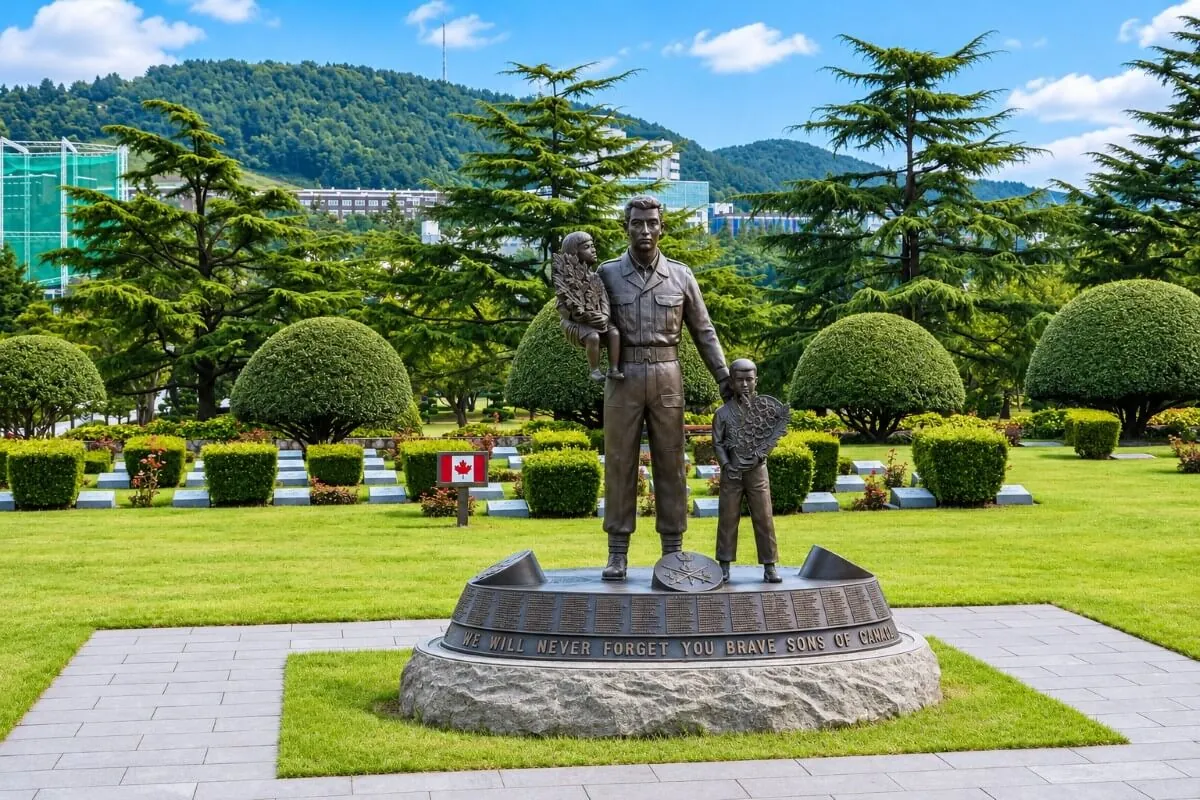
Immediately east of Gimhae, Busan adds Joseon frontier history, modern port development and Korean War heritage. The two cities are linked by light rail and form a natural combined itinerary in south-eastern Korea.

Gyeongju
The former Silla capital provides the clearest historical continuation after Gaya. Royal tombs, Buddhist temples and palace sites reveal the kingdom that eventually absorbed Geumgwan Gaya and dominated south-eastern Korea.