
Few wildlife scenes are as famous as the Japanese macaques of Jigokudani Snow Monkey Park sitting neck-deep in steaming water while snow falls around them. It looks ancient, almost as if these monkeys have been bathing in hot springs for centuries. They haven’t. The behaviour is surprisingly recent.
Jigokudani Yaen-Koen opened in 1964 as a place where wild Japanese macaques could be observed without cages or barriers. The park also helped reduce conflict between the monkeys and nearby farmers after habitat disturbance pushed them towards orchards and fields. Not long afterwards, a young macaque discovered the hot springs near a local inn. Other monkeys copied the behaviour, and a new tradition was born.
Today, those snow monkeys have become one of Nagano’s most famous attractions. But their story begins with a very different problem.
What Will You Discover?
- Why Is It Called Hell Valley?
- The Conflict Between Monkeys and Farmers
- How Jigokudani Snow Monkey Park Began
- How the Monkeys Learned to Use the Onsen
- What Makes Japanese Macaques Special?
- Why Do the Monkeys Bathe?
- When Is the Best Time to Visit?
- What Is It Like to Visit the Park?
- From Local Solution to Global Icon
- How to Get to Jigokudani Snow Monkey Park
Why Is It Called Hell Valley?
The name Jigokudani means “Hell Valley.” That sounds dramatic, but the landscape explains it. The park lies at around 850 metres above sea level in a steep valley carved by the Yokoyu River in northern Nagano Prefecture. Hot water and steam emerge naturally from the volcanic ground, while steep cliffs rise around the valley.
Winter conditions can be severe. Temperatures may fall to around –10°C, and snow can exceed one metre. For humans, that combination of rock, steam and deep winter snow suggested an entrance to hell. For Japanese macaques, however, the mountains were home.

The Conflict Between Monkeys and Farmers
The modern history of Jigokudani Snow Monkey Park began in the mid-twentieth century. Japanese macaques had long lived in the surrounding mountains, but changes to their habitat created problems. Forests were cleared as the region developed, including for ski tourism. Groups of macaques increasingly moved towards lower elevations, where farms and orchards offered an easy source of food. For farmers, that was disastrous.
Monkeys raided crops, damaged orchards and became increasingly difficult to tolerate. Hunting was one possible response.A local man named Sogo Hara, who later became the park’s first director, believed there had to be another solution. He had become fascinated by the macaques and wanted to protect them while also reducing the damage they caused to nearby farms. The answer was controlled feeding. By regularly providing food at Jigokudani, Hara and other locals encouraged the monkeys to remain in the valley instead of searching for food in agricultural areas. That eventually led to the creation of the park.

How Jigokudani Snow Monkey Park Began
Jigokudani Yaen-Koen officially opened in 1964. The idea was unusual. Instead of placing monkeys behind fences, visitors would enter the animals’ environment. The macaques remained wild and free-ranging. They could move in and out of the park whenever they wanted, while staff used carefully controlled feeding to encourage regular visits. That principle still defines the park today.
There are no cages separating visitors from the monkeys.At the same time, the park stresses that feeding is designed only to supplement the animals’ natural diet, not replace it. Visitors are not allowed to feed or touch them. Then something unexpected happened. The monkeys discovered the hot springs.

How the Monkeys Learned to Use the Onsen
The famous bathing behaviour did not exist when the macaques first came to Jigokudani. According to the park, a young monkey discovered the open-air bath at Korakukan, a nearby traditional inn. During cold weather, sitting in hot water was apparently rather pleasant. Other young monkeys began copying the behaviour. Eventually, more members of the troop followed.
There was one obvious problem: humans and monkeys sharing the same onsen wasn’t particularly hygienic. So in 1967, a separate outdoor bath was constructed specifically for the macaques. The behaviour then passed from one generation to another. This is what makes Jigokudani especially fascinating. You aren’t simply watching animals act on instinct. You are watching a socially transmitted behaviour — something learned, copied and preserved within the group.
What Makes Japanese Macaques Special?
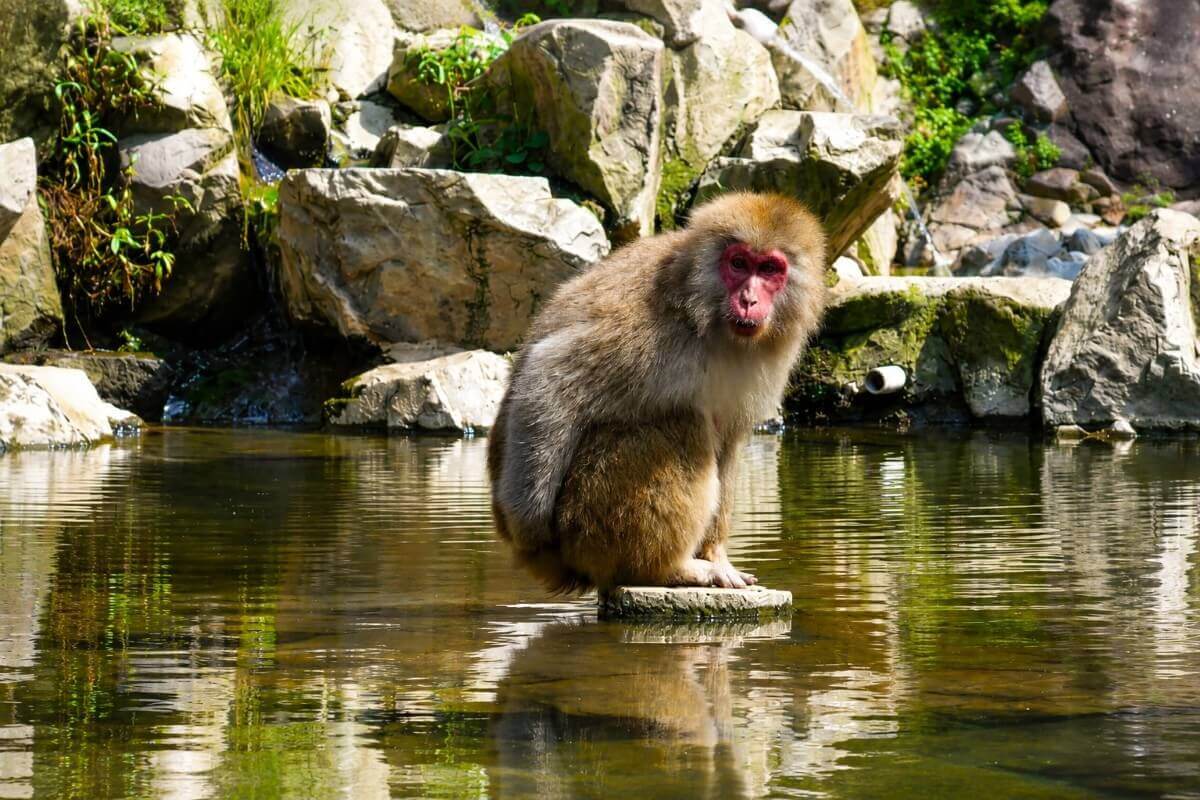
The monkeys at Jigokudani are Japanese macaques (Macaca fuscata), often called snow monkeys. They are native to Japan and live farther north than any other non-human primate. That means they have adapted to environments that would be extremely challenging for many other monkey species. Japanese macaques live in complex social groups with clear relationships between individuals. Grooming, play, conflict and cooperation form an important part of daily life.
Their diet is varied and may include fruits, leaves, seeds, roots, insects and other available foods. Spend enough time at Jigokudani and the most interesting moments often happen away from the hot spring. You may see mothers caring for young, individuals grooming one another, juveniles playing or older animals simply sitting quietly beside the river. The onsen may make them famous. Their social life makes them fascinating.

Why Do the Monkeys Bathe?
It might seem obvious: because they are cold. And research strongly supports that explanation. A long-term study of Jigokudani macaques found that hot-spring bathing became more common as temperatures dropped. Adult females and younger monkeys used the hot spring more often than adult males, and infants were more likely to bathe if their mothers did. So the behaviour appears to serve both thermoregulation and social learning.
Not every monkey enjoys bathing. Some rarely or never enter the water. And during warmer months, many have little reason to use it at all. That is important if you’re planning a visit. The fact that the monkeys are present does not guarantee that they’ll be sitting in the onsen.

When Is the Best Time to Visit?
If your dream is the classic photograph of snow-covered monkeys soaking in steaming water, visit in winter. The Japan National Tourism Organization recommends roughly December to March as the best period for seeing bathing behaviour. Snow creates the famous atmosphere, and low temperatures make the hot spring particularly attractive to the monkeys. But winter is not the only time worth visiting.
I visited in September.
There was no snow, and the weather was far too warm for most macaques to sit in the hot spring. But that didn’t make the visit disappointing. Without the winter spectacle, you start paying more attention to the animals themselves: their expressions, interactions and movement through the valley. Jigokudani is therefore a wildlife experience year-round. Just don’t expect the same experience in every season.

What Is It Like to Visit the Park?
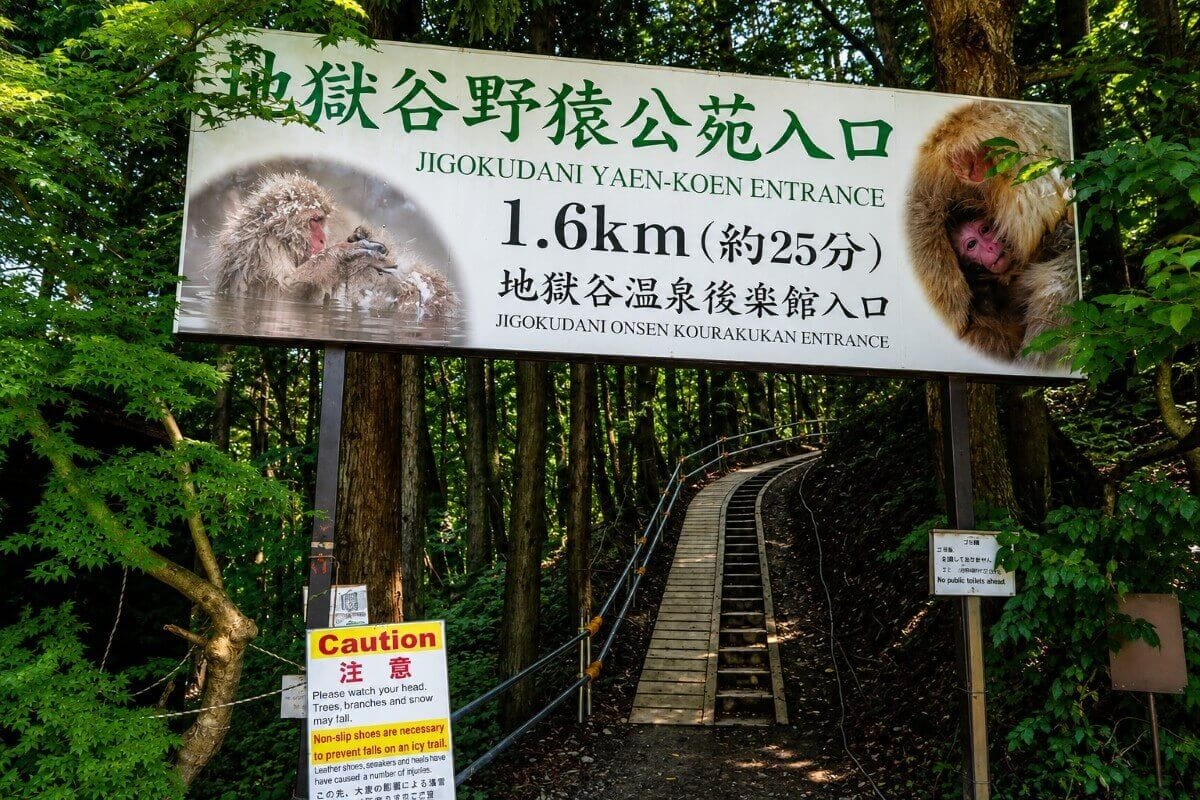
Part of the experience is simply getting there. From the nearest road and bus stops, visitors walk through forest before reaching the park. The approach is roughly 1.5–2 kilometres, depending on your starting point. The trail is easy in good weather, but winter snow and ice can make it slippery. Once inside, there is remarkably little separation between you and the macaques.
They may walk straight past you. That doesn’t mean they are tame. Keep your distance, don’t block their path, don’t touch them and never offer food. The park also warns that the monkeys are wild and may sometimes choose not to appear at all. Its official website publishes forecasts and live information on whether the troop is currently visiting. That unpredictability is actually part of what makes the place different from a zoo.
From Local Solution to Global Icon
Jigokudani’s monkeys didn’t remain a local curiosity for long. In 1970, an image of bathing Japanese macaques appeared prominently in LIFE magazine, helping spread the snow monkeys’ fame internationally. Since then, researchers, photographers and travellers from around the world have come to Jigokudani. But behind the famous photographs is a more complicated story. The park emerged from human changes to the landscape.
Feeding was introduced to reduce conflict between wildlife and agriculture. The monkeys then learned an entirely new behaviour from one another. And that behaviour ultimately turned Jigokudani into an international tourism destination. In other words, the Snow Monkey Park is not simply a place where monkeys happen to sit in hot water. It is a story about adaptation — both animal and human.

How to Get to Jigokudani Snow Monkey Park
From Nagano Station, travel by Nagano Dentetsu railway towards Yudanaka. From Yudanaka, buses connect towards the Snow Monkey Park area. Another option is to use direct seasonal or express bus services from Nagano when available. From the bus stop or Kanbayashi Onsen area, continue on foot through the forest to Jigokudani Yaen-Koen. Opening hours and admission fees vary by season, so I would check the official website shortly before visiting rather than relying on older prices.
More importantly, check the live monkey status. Because unlike a zoo, Jigokudani cannot promise that its stars will turn up on schedule. And that is perhaps exactly how it should be. The Japanese macaques are not exhibits. They are wild animals that have learned to make one extraordinary valley — and one very warm pool — part of their lives.
Return to:
