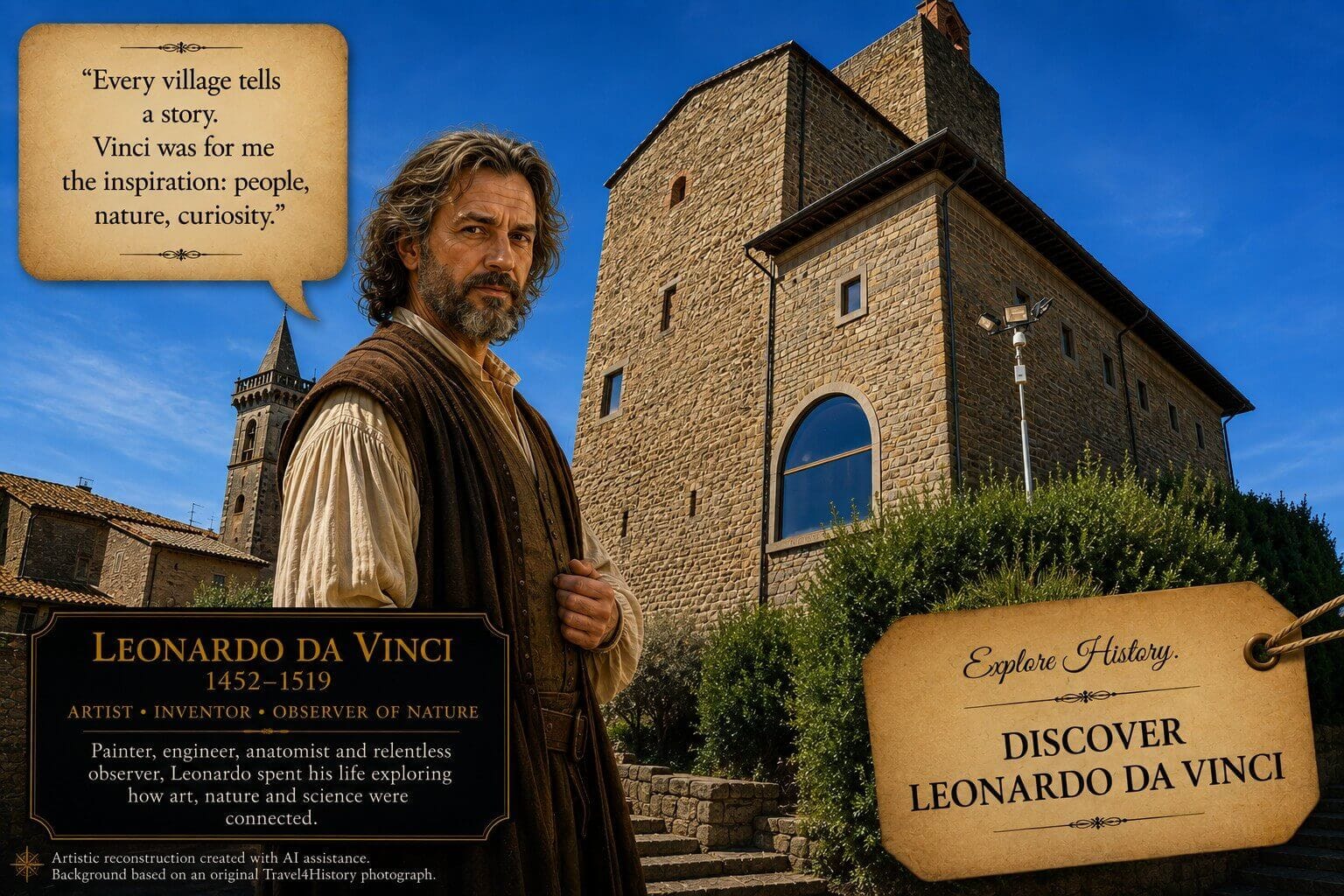
Vinci may be small, but few towns can claim such an extraordinary connection with history. This Tuscan hill town gave its name to Leonardo da Vinci, and today you can explore his machines, stand beside the font where he was baptized, walk through the landscape of his childhood and visit the traditional site of his birth.
At first sight, Vinci looks like many other small towns in Tuscany. Stone houses climb a hillside, olive groves cover the surrounding countryside and an old castle tower rises above the rooftops. But then you start noticing the name. Leonardo. It appears on museums, streets, statues and exhibitions throughout the town. For good reason.
Leonardo da Vinci was born in this area on 15 April 1452, and although he would later become associated with Florence, Milan, Rome and France, Vinci remained the landscape of his earliest years. Today, the town offers something very different from seeing the Mona Lisa in Paris or The Last Supper in Milan.
Here, you can explore where Leonardo came from. The best way to visit Vinci is therefore not to rush through one museum and leave. Give yourself at least a full day and connect the historic centre with the countryside towards Anchiano. These are the 7 best things to see and do in Vinci.
What Will You Discover in Vinci?
- Museo Leonardiano – Inside Leonardo’s Mechanical Mind
- Casa Natale di Leonardo – His Traditional Birthplace
- Santa Croce – Where Leonardo Was Baptized
- Leonardo e la Pittura – Discover His Paintings
- Strada Verde – Walk Through Leonardo’s Tuscany
- Centro Espositivo Leo-Lev – Contemporary Culture in Vinci
- Parco Acquaria – Relax with Views of Vinci
- How Much Time Do You Need in Vinci?
- Is Vinci Worth Visiting?

1. Enter Leonardo’s Mechanical World at Museo Leonardiano
If you only have time for one museum, make it the Museo Leonardiano. The museum occupies two historic buildings in the centre of Vinci: Palazzina Uzielli and the medieval Castello dei Conti Guidi. But don’t expect original Leonardo paintings. The focus here is Leonardo as an engineer, observer and investigator. Models reconstructed from his drawings help explain his studies of mechanics, construction, hydraulics, flight, textile technology and military engineering.
One of the most interesting things about the museum is understanding that many of the objects aren’t surviving machines made by Leonardo himself. They are attempts to transform his drawings into three-dimensional models. That makes the museum less about admiring a mythical inventor and more about asking:
How did Leonardo think?
Take your time with the mechanisms rather than simply walking past them. And before leaving the castle, climb the tower. From the top, you get one of the best views across Vinci and the Tuscan countryside.
Allow: around 1½–2 hours.
Read more: Museo Leonardiano: Inside the Mechanical Mind of Leonardo da Vinci
2. Visit Leonardo’s Traditional Birthplace in Anchiano
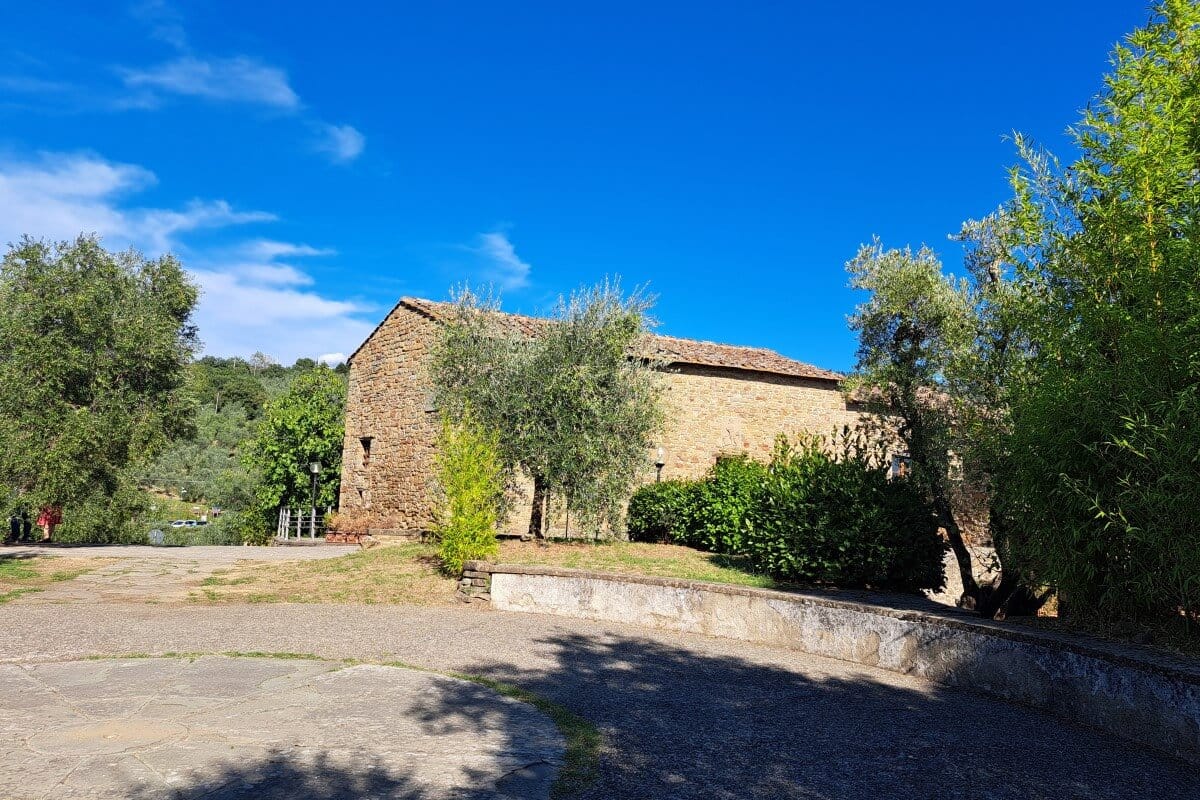
About three kilometres outside Vinci lies Anchiano, where a modest stone farmhouse is traditionally identified as Leonardo da Vinci’s birthplace. Today it is the Casa Natale di Leonardo da Vinci. The important word here is traditionally. We know Leonardo was born in the Vinci area on 15 April 1452, and the Anchiano property has genuine historical connections with the da Vinci family. But no surviving document proves that Leonardo was born inside this exact house.
That uncertainty actually makes the place more interesting. Casa Natale isn’t a perfectly preserved Renaissance home filled with Leonardo’s possessions. Instead, multimedia presentations and reproductions introduce his life and his relationship with the landscape. The real attraction, in my opinion, is the setting. Stand outside and look across the olive-covered hills. Before Leonardo became the legendary Renaissance master, this was the world surrounding the young boy from Vinci.
Allow: around 45 minutes to one hour.
Read more: Casa Natale di Leonardo da Vinci: Was Leonardo Really Born Here?

3. Stand Beside Leonardo’s Baptismal Font at Santa Croce
The Church of Santa Croce may look modest compared with Tuscany’s great cathedrals. Historically, however, it contains one of the most tangible links to Leonardo’s childhood. Leonardo was baptized here in April 1452 by parish priest Piero di Bartolomeo Cecchi. His grandfather Antonio recorded the baptism in the same family document that records Leonardo’s birth. Inside the church, a separate baptistery contains the ancient stone font traditionally associated with his baptism. The surrounding baptistery is modern — it was created during the celebrations for the 500th anniversary of Leonardo’s birth in 1952 — but the font itself is much older.
Santa Croce has also been rebuilt extensively over the centuries, so Leonardo wouldn’t recognise much of the church as it appears today. That makes the surviving baptismal font all the more remarkable. Before the machines, paintings and famous notebooks, there was simply a newborn child being welcomed into the community of Vinci.
Allow: around 20–30 minutes.
Read more: Chiesa di Santa Croce: Where Leonardo da Vinci Was Baptized

4. See Leonardo’s Paintings Together at Leonardo e la Pittura
There is one obvious problem with creating a Leonardo museum in Vinci. His greatest paintings aren’t here. The Mona Lisa is in Paris. The Last Supper remains in Milan. Other paintings are scattered among collections in Florence, Kraków, London, Washington and elsewhere. Leonardo e la Pittura solves that problem in an unusual way. Rather than pretending to possess original masterpieces, the exhibition brings together high-resolution, life-size reproductions of Leonardo’s paintings.
That allows you to compare works that would otherwise require travelling across several countries. The exhibition is especially useful if you’re interested in Leonardo as a painter rather than primarily as an engineer. Don’t visit expecting priceless originals. Visit because it gives you an opportunity to examine Leonardo’s artistic development in one place. I would combine it with Museo Leonardiano: one explores the mechanical mind, the other the painter.

5. Walk the Strada Verde Through Leonardo’s Landscape
You could simply drive from Vinci to Anchiano. But if the weather is good, don’t. Walk the Strada Verde instead. This roughly 1.8-kilometre trail connects Vinci with Leonardo’s traditional birthplace through olive groves, vineyards and the slopes of Montalbano. The route is often described as walking in Leonardo’s footsteps. Historically, I would be a little more cautious: we cannot prove that Leonardo regularly walked every metre of the modern marked trail.
But you are unquestionably walking through his landscape. And there is one particularly interesting historical detour. Near the route are the remains associated with the Mulino della Doccia, an old watermill installation Leonardo later recorded in the Codex Atlanticus. That connection is much more meaningful than simply saying the countryside “inspired” Leonardo. It shows him observing and recording real technology from the landscape around his native town.
In the nineteenth century another famous Italian walked this route: Giuseppe Garibaldi, who reportedly visited Leonardo’s house while staying nearby. So the Strada Verde isn’t merely a pretty Tuscan walk. It connects landscape, Leonardo and centuries of fascination with him. Allow: 40–60 minutes each way if you stop for photographs.
Read more: Strada Verde: Walking Through Leonardo da Vinci’s Tuscany

6. Discover Contemporary Art at Centro Espositivo Leo-Lev
After spending several hours immersed in Leonardo, the Centro Espositivo Leo-Lev offers something different. The exhibition centre is devoted to art and cultural exhibitions rather than simply recreating Leonardo’s machines or telling his biography. That makes it a useful counterpoint to the other sights in Vinci. The town’s identity may be dominated by a man born in 1452, but Vinci isn’t frozen in the Renaissance.
Check the programme before visiting, because exhibitions can change. I would therefore treat Leo-Lev as an optional addition rather than an essential Leonardo attraction. If the current exhibition interests you and you have enough time, add it to your afternoon. If you’re spending only half a day in Vinci, prioritise Museo Leonardiano, Santa Croce and either Casa Natale or the Strada Verde.

7. Slow Down at Parco Acquaria
Finally, Vinci doesn’t need to be all museums. Parco Acquaria lies along the route towards Anchiano and combines nature with artistic elements inspired by Leonardo. But its greatest attraction is simpler: the view.
From around the park you can look back towards Vinci, with the medieval castle rising above the rooftops and the Tuscan landscape spreading around it. It’s a good place to stop during the Strada Verde walk, particularly if you’re travelling with children or simply want a break from museums.
I wouldn’t travel to Vinci specifically for Parco Acquaria. But as part of the walk between the town and Anchiano, it fits perfectly. And sometimes sitting beneath the Tuscan sun looking back at Vinci tells you more about Leonardo’s origins than another display case ever could.

How Much Time Do You Need in Vinci?
You can see the main sights in half a day. I wouldn’t recommend it. A full day gives you enough time to experience Vinci without constantly checking the clock. A good itinerary would be:
Morning: Santa Croce – Museo Leonardiano – castle tower
Lunch: Historic centre of Vinci
Afternoon: Strada Verde – Parco Acquaria – Mulino della Doccia – Casa Natale in Anchiano
Then either walk back to Vinci or arrange your transport accordingly. If you’re particularly interested in Leonardo, you could easily spend longer and add Leonardo e la Pittura and a temporary exhibition at Leo-Lev.
Is Vinci Worth Visiting?
If you’re expecting Florence, no. Vinci is tiny. There is no Uffizi, no enormous cathedral and no collection of original Leonardo masterpieces. But that’s exactly why the town is interesting. Florence shows you the Renaissance world in which Leonardo became an artist. Milan shows you what he accomplished at one of Italy’s great courts. Paris possesses his most famous painting.
Vinci gives you Leonardo before all of that.
Here you can stand beside the font associated with his baptism. You can look across the countryside of his childhood. You can walk towards the traditional place of his birth. And inside Museo Leonardiano, you can see how generations of researchers have tried to understand the ideas he left on paper. Leonardo eventually travelled far beyond these Tuscan hills. His name didn’t.
More than five centuries later, he is still:
Leonardo da Vinci, Leonardo from Vinci.
And that’s what makes this small Tuscan town worth the journey.
Return to: