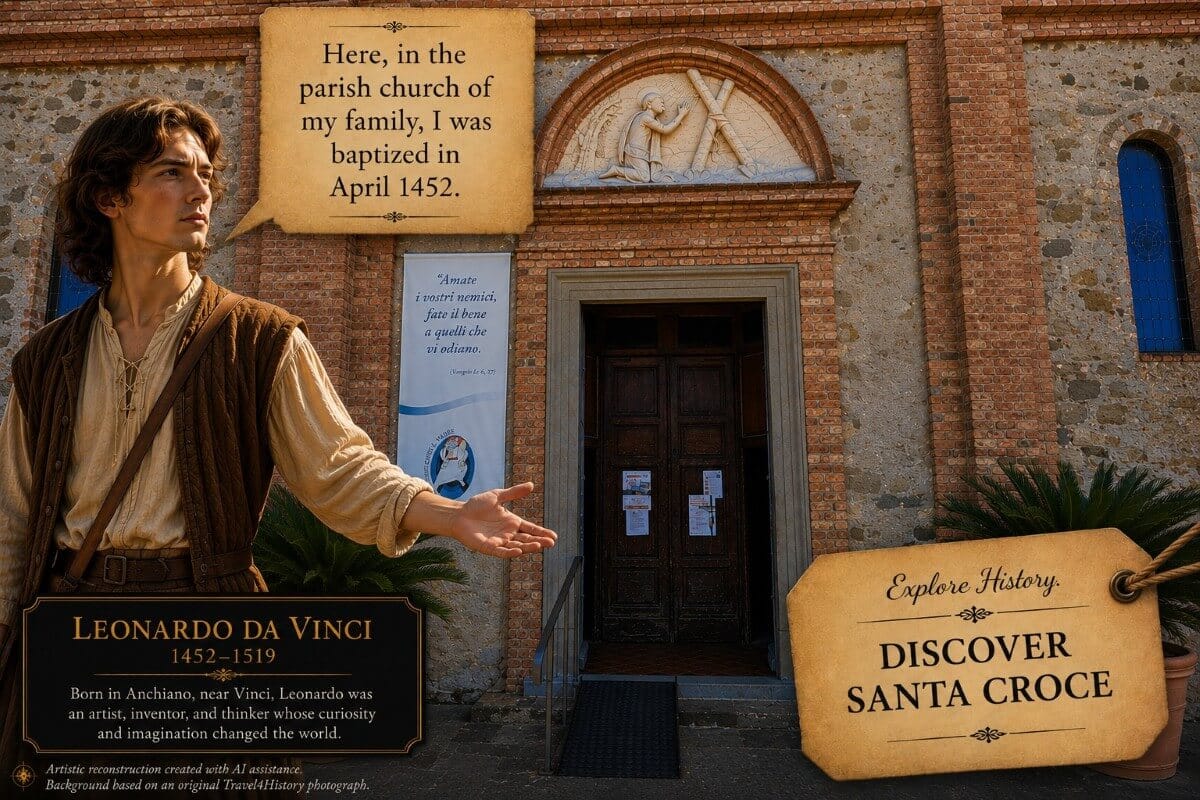
On 16 April 1452, a newborn child was carried into the parish church of the small Tuscan village of Vinci. His name was Leonardo. Nobody standing around the baptismal font could have known that the illegitimate son of a local notary would become one of the most famous figures of the Renaissance. There was no Mona Lisa, no Last Supper, no flying machine and no notebooks filled with anatomical drawings.
There was simply a baby, a priest and a baptism.
More than five centuries later, the Church of Santa Croce still stands in the heart of Vinci. The medieval church Leonardo knew has largely disappeared, transformed by centuries of rebuilding. But one remarkable object survived: the ancient baptismal font traditionally associated with Leonardo’s baptism. For anyone following Leonardo’s footsteps through Vinci, this modest church therefore tells an important part of his story.
What would you like to know about Santa Croce?
- Leonardo’s First Day in Vinci
- What Do We Know About His Baptism?
- The Ten People Who Witnessed It
- The Baptismal Font That Survived
- What Happened to Leonardo’s Medieval Church?
- Inside Santa Croce Today
- A Small Place in an Enormous Story
- Visiting the Church of Santa Croce

Leonardo’s First Day in Vinci
Leonardo was born on 15 April 1452. His father was Ser Piero da Vinci, a notary from a respected local family. His mother, Caterina, was not married to Piero, making Leonardo an illegitimate child. Fortunately, one member of the family left us an unusually valuable record of the event. Leonardo’s paternal grandfather Antonio da Vinci recorded his grandson’s birth on the final page of an old family notarial register. He noted that Leonardo had been born on Saturday, 15 April, at three hours into the night and had been given the name Lionardo.
Antonio then recorded something else: the name of the priest who baptized him. That small entry allows us to follow Leonardo from the uncertainty surrounding his exact birthplace to somewhere much more tangible. Santa Croce.
While historians still debate exactly where in Vinci Leonardo was born, his baptism is much better documented. Santa Croce was the parish church of the da Vinci family, who owned several properties within its parish. Leonardo was baptized here in April 1452 by the parish priest Piero di Bartolomeo Cecchi.
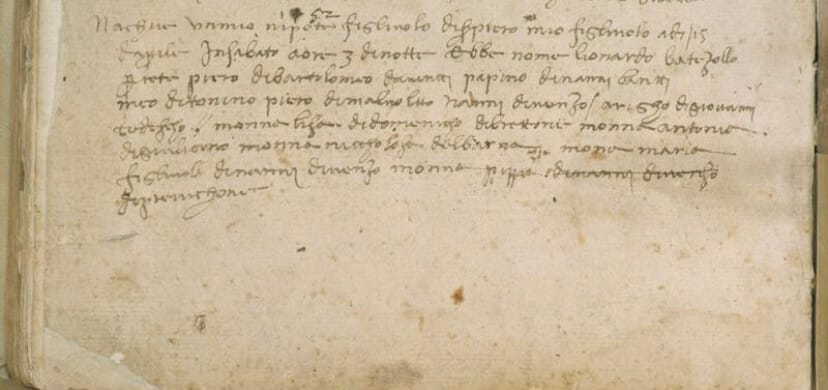
Source: Archivio di Stato di Firenze, Notarile antecosimiano 16912, f. 105v. Public Domain.
What Do We Know About Leonardo’s Baptism?
Leonardo was baptized on 16 April 1452, the day after his birth. The priest was Piero di Bartolomeo Cecchi, parish priest of Santa Croce. The baptism itself would have been an important religious and social moment. In fifteenth-century Tuscany, baptism brought a newborn child formally into the Christian community.
But Leonardo’s baptism is especially interesting because Antonio’s short record gives us something surprisingly personal. It names the people who were there. And there were quite a few of them.
The Ten People Who Witnessed It
Antonio recorded ten godparents — five men and five women — in connection with Leonardo’s baptism. Museo Leonardiano also confirms the presence of ten godfathers and godmothers. That little detail changes the way I imagine the scene. Leonardo is often presented as the solitary genius: an extraordinary individual somehow standing apart from everyone around him.
But the first documented religious ceremony of his life places him right in the middle of a community. Neighbours and acquaintances gathered around the infant. His father’s family belonged to Vinci. Their houses and properties were here. Santa Croce was their parish church. Long before Leonardo became associated with Florence, Milan and the courts of Renaissance Italy, he belonged to this small Tuscan world.
That makes Santa Croce different from many places connected with Leonardo today. You don’t have to imagine that he might once have passed through here. His baptism connects him directly to this church.

The Baptismal Font That Survived
Walk inside Santa Croce today and turn towards the baptistery. At its centre stands an ancient stone baptismal font. This is particularly significant because the church around it has changed enormously since Leonardo’s lifetime. The medieval building once frequented by the da Vinci family was transformed so extensively that little of Leonardo’s church remains recognizable today.
The old baptismal font, however, survived. It is believed to be the font at which Leonardo was baptized in April 1452. Its present surroundings are much newer. For the 500th anniversary of Leonardo’s birth in 1952, architect Ugo Giulio Arata designed an octagonal baptistery within spaces formerly belonging to the Oratory of the Compagnia del Corpus Domini. The historic font was installed at its centre, and the baptistery was inaugurated on 15 April 1952.
In 2010, another layer was added to the story when Italian sculptor Cecco Bonanotte created a series of metal sculptures entitled The Baptism of Leonardo. So what you see today is actually a meeting of different centuries: a Renaissance font, a twentieth-century commemorative space and modern artwork, all centred around an event from 1452.

What Happened to Leonardo’s Medieval Church?
Santa Croce is old — but don’t make the mistake of assuming Leonardo would recognize the building you see today. A church here is documented as early as 1132, when sources mention the cappella de Vincio. The title of Santa Croce appeared later, during the thirteenth century. It originally formed part of the religious life of the fortified settlement around the nearby castle of the Counts Guidi.
Over the centuries, however, Santa Croce was repeatedly altered. Its bell tower was inaugurated in 1855, while the church underwent a particularly radical transformation during the 1920s and 1930s. Those works gave Santa Croce much of its present Neo-Renaissance appearance. This is worth remembering when visiting.
The walls around you don’t provide an untouched window into Leonardo’s childhood. Instead, Santa Croce is a building made up of historical layers. And perhaps that makes the survival of the baptismal font even more remarkable.
Inside Santa Croce Today
Leonardo may be the reason many travellers enter the church, but don’t leave immediately after seeing the baptistery. Santa Croce contains several other reminders of its long religious history. The interior has three naves, with chapels dedicated to Saint Andrew and the Blessed Sacrament. The Chapel of the Crucifix contains a wooden crucifix dating from the first half of the fifteenth century — roughly the world into which Leonardo was born — together with relics of the Holy Cross and an image of Our Lady of Sorrows.
Among the paintings are Francesco Brina’s Nativity of the Virgin of 1562, Gaetano Piattoli’s Miracle of Saint Blaise and an Adoration of the Magi by Pier Dandini. They belong to periods after Leonardo, but they help remind us that Santa Croce did not become important simply because a famous man had once been baptized here. For centuries, this has been the church of the local community. Leonardo is one chapter in a much longer story.

A Small Place in an Enormous Story
Santa Croce isn’t a spectacular Renaissance cathedral. You won’t need hours to explore it. But after visiting Leonardo’s museums, seeing reconstructions of his machines and reading about the extraordinary things he later achieved, this small church offers something completely different. It takes the story back to the beginning.
Before Leonardo became Leonardo da Vinci, one of history’s most celebrated artists and thinkers, he was simply Lionardo: the newborn grandson whose arrival Antonio da Vinci recorded in a family book. On the following day, he was brought to the parish church. More than 570 years later, you can still stand beside the font associated with that moment. Sometimes the smallest historical objects bring us closest to the people behind the history.

Visiting the Church of Santa Croce in Vinci
The Church of Santa Croce stands in the historic centre of Vinci, only a short walk from the Castello dei Conti Guidi and Museo Leonardiano. Allow approximately 20–30 minutes if you mainly want to see Leonardo’s baptistery and the principal artworks. Entrance to a functioning church should of course be approached respectfully, particularly during services.
I would combine Santa Croce with the Museo Leonardiano and then continue towards Leonardo’s Birthplace at Anchiano. Together, the three places tell three very different stories: the church connects you with Leonardo’s earliest documented days, the museum explores his ideas and machines, while Casa Natale focuses on the landscape and tradition surrounding his birth.
For current accessibility and visitor information, check Vinci’s official tourism information before your visit.
Explore more about Leonardo & Vinci
- Casa Natale di Leonardo da Vinci: Was Leonardo Really Born Here?
- Museo Leonardiano: Inside the Mechanical Mind of Leonardo da Vinci
- Strada Verde: Walking Through Leonardo da Vinci’s Tuscany
- Vinci, Italy: 7 Best Things to See & Do in Leonardo’s Hometown
- Who Was Leonardo da Vinci? 7 Facts About Leonardo and Vinci
Return to: