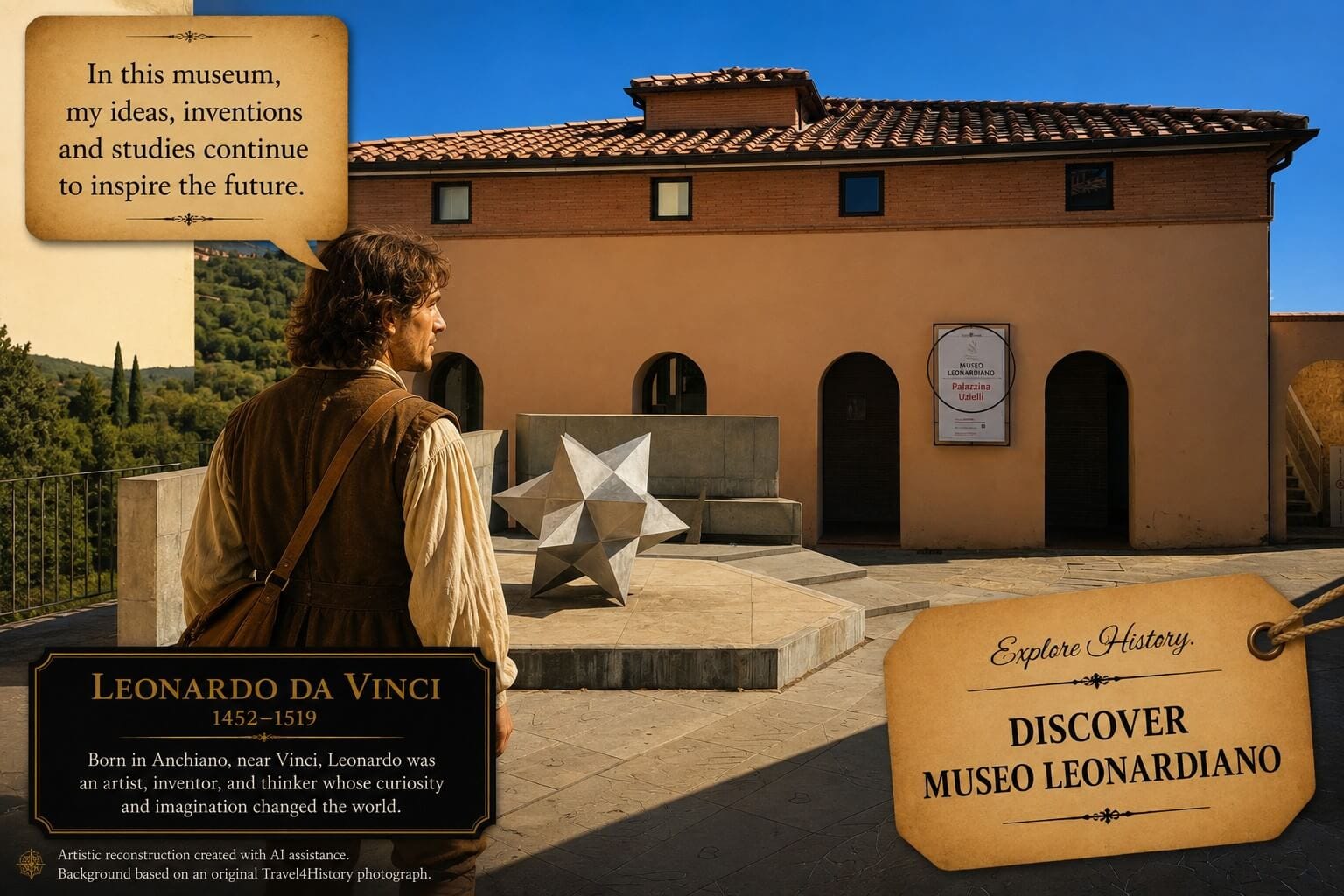
Leonardo da Vinci never built most of the machines that today carry his name. Instead, he filled notebooks with gears, wings, cranes, hydraulic systems and mechanical devices — sometimes designs for practical machines, sometimes improvements to existing technology, and sometimes investigations into how movement itself worked. More than four centuries after his death, people in Leonardo’s hometown began asking a fascinating question:
What would happen if we turned those drawings into three-dimensional machines?
The answer can be found inside the Museo Leonardiano in Vinci. Spread across two historic buildings in the centre of town, the museum uses models, manuscripts and digital reconstructions to explore Leonardo not primarily as the painter of the Mona Lisa, but as an engineer, observer and relentless investigator of the world around him. And there could hardly be a more appropriate place for it. This is the landscape where Leonardo’s story began.
What would you like to know about Museo Leonardiano?
- Leonardo Left Drawings, Not a Museum of Machines
- A Museum Born in Leonardo’s Hometown
- Two Buildings, One Story
- Palazzina Uzielli – Understanding Leonardo’s Mechanics
- Inside the Castle – Flight, War and Engineering
- Leonardo and the Power of Water
- Leonardo and Painting
- The View from the Castle Tower
- Visiting Museo Leonardiano

Leonardo Left Drawings, Not a Museum of Machines
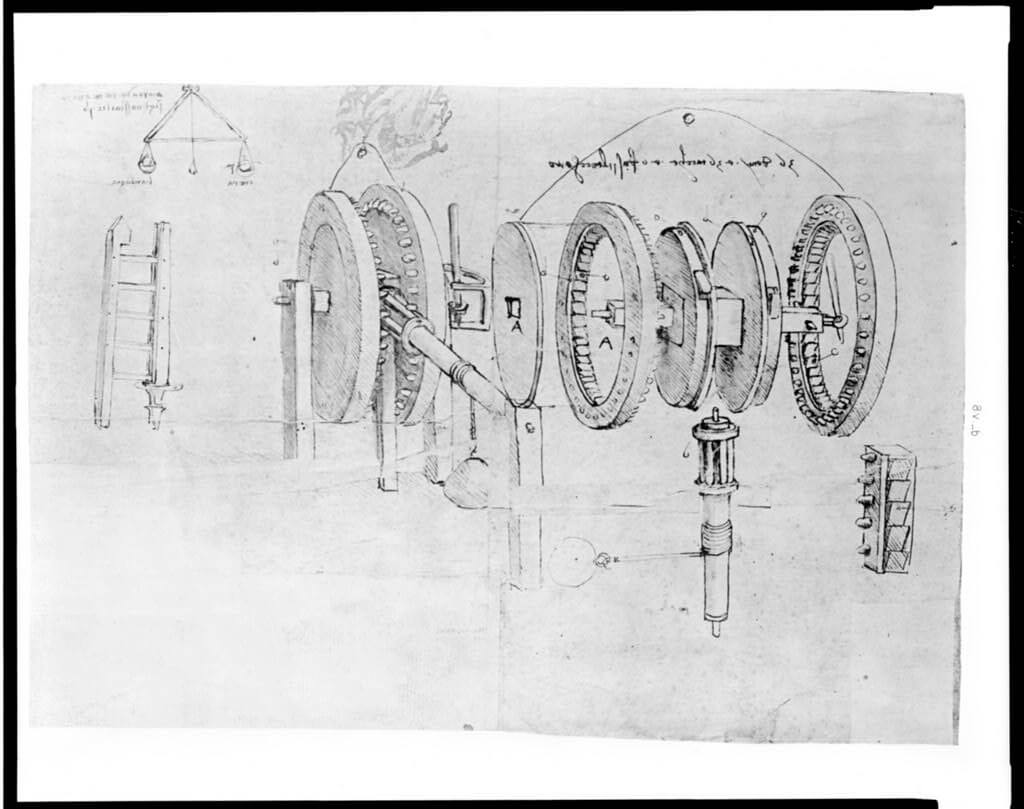
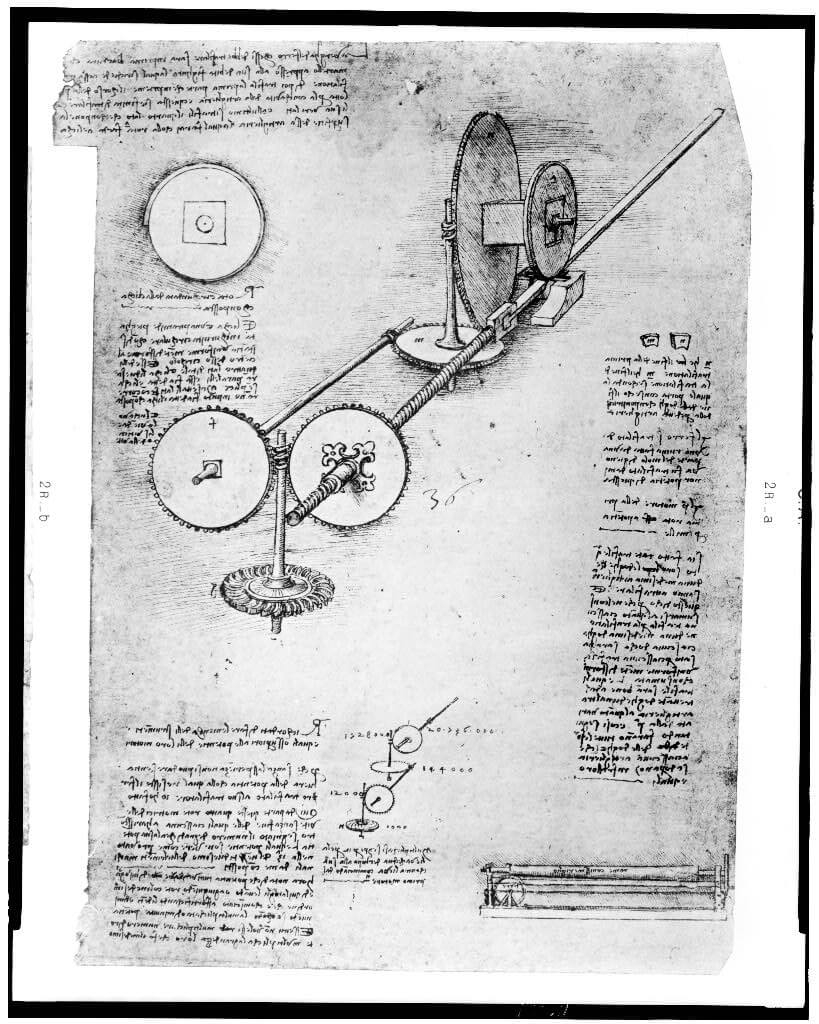
One misconception is worth clearing up before entering Museo Leonardiano. The wooden machines you see here are generally not surviving machines built by Leonardo himself. Leonardo left behind thousands of pages containing sketches, observations and technical studies. Among them are cranes, gears, flying machines, textile equipment, hydraulic devices and mechanisms designed to transfer or transform movement.
Some ideas were connected to technologies that already existed in Renaissance Europe. Others show Leonardo experimenting, improving or imagining new possibilities. The museum therefore isn’t simply displaying “Leonardo’s inventions.” It is doing something more interesting. Researchers have studied his drawings and attempted to translate the lines on those pages into physical models. Standing in front of them allows you to see relationships that are sometimes difficult to understand from a manuscript alone.
Suddenly, a sketch becomes a mechanism. And Leonardo’s thought process begins to move.
Source: Reproduced from the Codex Atlanticus, c. 1894–1904. Library of Congress. No known restrictions on publication.
A Museum Born in Leonardo’s Hometown
The story of the museum began long after Leonardo’s death. In 1919, during commemorations marking 400 years since his death, the medieval Castello dei Conti Guidi was donated to the Municipality of Vinci. The idea of creating a museum dedicated to Leonardo in his native town developed from these celebrations. The castle was restored between 1939 and 1942, but the decisive moment came after the Second World War.
On 15 April 1953 — Leonardo’s birthday — the Museo Vinciano opened its doors. There was an unusual contributor to its creation: IBM. The company donated a complete series of models reconstructed from Leonardo’s drawings to the Municipality of Vinci. Initially displayed in only four rooms of the castle, they became the foundation of a collection that has continued to expand through research, donations and new reconstructions.
That history makes Museo Leonardiano interesting in its own right. You are not only looking at Leonardo’s Renaissance ideas. You are also looking at generations of attempts to understand them.
Source: Reproduced from the Codex Atlanticus. Library of Congress. No known restrictions on publication.
Two Buildings, One Story
Today Museo Leonardiano occupies two principal buildings in Vinci: Palazzina Uzielli and the medieval Castello dei Conti Guidi. They couldn’t look much more different. Palazzina Uzielli is a nineteenth-century building named after Gustavo Uzielli (1839–1911), an important nineteenth-century scholar of Leonardo. It was restored and opened as part of the museum in 1997. The castle, by contrast, takes you much further back into Vinci’s past.
Standing above the village since the twelfth century, the Castello dei Conti Guidi is traditionally called the “Castle of the Ship.” Its elongated form and tower were thought to resemble a sailing vessel, with the tower rising like a mast. Together the two buildings form a journey through Leonardo’s mechanical world.

Palazzina Uzielli – Understanding Leonardo’s Mechanics
Your visit begins in Palazzina Uzielli. Rather than immediately confronting you with spectacular flying machines, this part of the museum introduces something fundamental to understanding Leonardo: mechanics.
The galleries examine construction machinery, textile technology and mechanical clocks, before moving towards Leonardo’s studies of anatomy and what the museum calls the “Anatomy of Machines.” That combination is revealing. Leonardo wanted to understand how things worked — whether the subject was a pulley, a gear or the human body. He broke complex systems into individual components and studied the relationships between them.
A machine could almost be dissected. A body could almost be studied as a machine. Modern digital reconstructions help demonstrate how the mechanisms represented in Leonardo’s drawings might have functioned. Some reconstructed mechanisms can also be explored interactively. It is here that the famous Renaissance genius begins to feel less mythical and much more human: a man endlessly asking how?
Inside the Castle – Flight, War and Engineering
From Palazzina Uzielli, continue to the Castello dei Conti Guidi. Here Leonardo’s ideas become more ambitious. The museum explores civil engineering, military machines, mechanisms, tools and flight, including a large articulated wing reconstructed from his studies. Leonardo’s fascination with flight is particularly compelling because it reveals his method so clearly. He didn’t simply imagine a machine and draw it.
He observed nature. Birds, wings, air and movement became subjects to investigate. Leonardo attempted to understand the principles behind flight before translating them into mechanical possibilities. Whether all these machines could actually have worked is almost beside the point. The drawings reveal a mind unwilling to accept that something was impossible simply because nobody had yet explained how to do it.

Leonardo and the Power of Water
One of the most appropriate sections for a museum in Vinci concerns water. Leonardo studied rivers throughout his life. He investigated currents, erosion, canals, hydraulic engineering and ways in which waterways might be controlled or redirected. The upper part of the castle explores these hydraulic studies, with particular attention to projects connected with Leonardo’s native Tuscany. The museum also connects them with his landscape drawings and his attempts to understand how nature continually transforms the land.
This is where the location of Museo Leonardiano becomes especially meaningful. Step outside and Tuscany is still there. The hills, valleys and waterways surrounding Vinci were part of the landscape Leonardo encountered as a boy. The museum therefore isn’t isolated from its subject: it stands within the environment that helped shape his curiosity.

Leonardo Was More Than an Inventor
After seeing gears, wings and machines, it would be easy to forget something obvious: Leonardo was also one of history’s greatest painters. A separate section called Leonardo and Painting, located at Via Roma 23/A, presents high-resolution, life-size reproductions of his paintings together in one place. Don’t expect original Leonardo paintings here.
Instead, the exhibition is designed to help visitors compare works that today are scattered among museums and collections around the world. For me, that distinction is important. Museo Leonardiano isn’t trying to compete with the Louvre or the Uffizi. Its purpose is interpretation: showing how Leonardo’s artistic, scientific and technical interests belonged to the same extraordinarily curious mind.

Climb the Tower Before You Leave
There is one final thing I wouldn’t miss. Climb the tower of the Castello dei Conti Guidi. From its panoramic terrace, the roofs of Vinci lie below you and the Tuscan countryside stretches towards the horizon. The museum itself describes this landscape as an important setting for understanding Leonardo’s childhood and his observations of nature. After spending an hour looking at Leonardo’s machines and drawings, the view suddenly feels different.
For centuries Leonardo has been turned into a universal genius: painter, engineer, anatomist, inventor and visionary. Up here, he becomes local again. Before Florence, Milan, Rome and France, there was Vinci. And perhaps that is the real strength of Museo Leonardiano. It doesn’t simply ask you to admire what Leonardo achieved. It encourages you to look at the world in the way he did — and ask how it works.

Visiting Museo Leonardiano
Allow around 1½ to 2 hours for the main museum if you want to examine the models rather than simply walk through the rooms. The museum’s own standard guided itinerary lasts approximately 90 minutes. The museum consists of Palazzina Uzielli, Castello dei Conti Guidi and Leonardo and Painting. Leonardo’s Birthplace at Anchiano can also be combined with the museum on a cumulative ticket.
Opening hours vary by season. At the time of writing, the museum lists 09:30–19:00 from 1 April to 1 November, while winter opening hours are shorter. The castle’s panoramic terrace has its own schedule and may close because of bad weather. Because hours and temporary closures can change, I recommend checking the museum’s website immediately before visiting.
Explore more about Leonardo & Vinci
- Casa Natale di Leonardo da Vinci: Was Leonardo Really Born Here?
- Chiesa di Santa Croce: Where Leonardo da Vinci Was Baptized
- Strada Verde: Walking Through Leonardo da Vinci’s Tuscany
- Vinci, Italy: 7 Best Things to See & Do in Leonardo’s Hometown
- Who Was Leonardo da Vinci? 7 Facts About Leonardo and Vinci
Return to: